Gold
Should I Buy Gold Now or Wait? What 26 Years Show
Gold has had an extraordinary couple of years. It started 2025 at $2,669 an ounce, crossed $3,000, then $4,000, then $5,000, and closed at a record $5,318.40 on January 29, 2026. The next day it fell almost 11%. By July it was below $4,000, and on October 7, 2026 it closed at $4,140.70.
If you have been meaning to buy gold, that history leaves you in an awkward spot. The price is well below its peak, which feels like an opportunity, but it is also far above where it was two years ago, which feels like a risk. So you are wondering whether to act now or hold off.
No one can tell you what gold will do next, and anyone who claims to know should make you more careful, not less. What this guide offers instead is a look at what 26 years of daily gold prices say about trying to time a purchase, an honest list of reasons on each side, and a way to decide that does not rely on calling the market.
The short answer: in the past, gold has rewarded people who bought and held far more often than people who waited for a lower price. A dip of 20% within a year was rare, and buying all at once beat spreading purchases out about three times in four. But there were long, painful stretches, including nearly nine years after 2011 when gold stayed below its peak. Decide first whether owning gold suits your situation, then choose an amount you could hold through a long slump, and the timing question gets much smaller.
This is general information, not financial advice. The prices on this page are COMEX gold futures daily closes, the series drawn in the charts, through October 7, 2026.
Claim Augusta's Free Gold IRA Kit
Gold's price today, from different starting points
On October 7, 2026, gold closed at $4,140.70 an ounce. Whether that looks cheap or expensive depends on the date you compare it with.
| Starting point | Gold then | Change to $4,140.70 |
|---|---|---|
| August 30, 2000 | $273.90 | About 15 times higher |
| October 7, 2016 | $1,248.90 | Up 232% |
| October 7, 2021 | $1,759.20 | Up 135% |
| January 2, 2025 | $2,669.00 | Up 55% |
| October 7, 2025 | $4,004.40 | Up 3% |
| January 2, 2026 | $4,329.60 | Down 4% |
| January 29, 2026, the record close | $5,318.40 | Down 22% |
Someone who has owned gold for ten years has more than tripled their money in dollar terms. Someone who bought at New Year has a small loss, and someone who bought at the January peak is down more than a fifth. The price is the same for all three. Your feelings about "now" are shaped by a reference point that has no bearing on what happens next, so it helps to notice which one you are using.
Gold's price since 2000
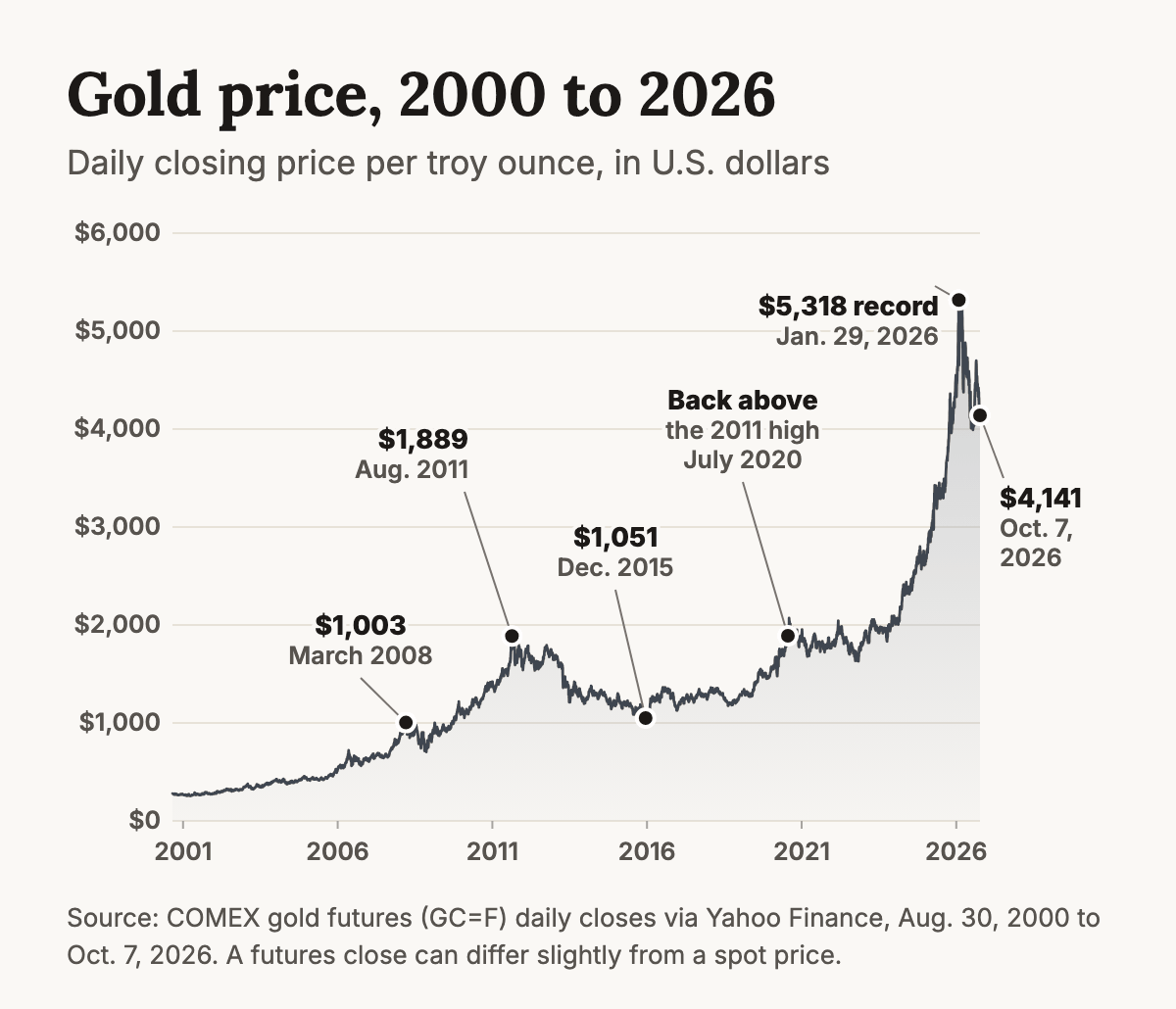
Five periods stand out on the chart.
A decade of gains, 2001 to 2011. Gold closed under $300 throughout 2001. It rose steadily through the decade and passed $1,000 for the first time in March 2008. In the financial crisis that followed, it fell from $1,003.20 on March 18 to $704.90 on November 13, a drop of 30%. Then it more than doubled again, to $1,888.70 on August 22, 2011.
The long correction, 2011 to 2015. From that peak, gold slid for more than four years. On April 15, 2013, it fell 9.4% in a single day. It bottomed at $1,050.80 on December 17, 2015, 44% below the 2011 high, the deepest fall from a peak anywhere in our 26-year series.
The waiting years, 2016 to 2019. Gold recovered slowly. For several years it spent most of its time between roughly $1,150 and $1,350.
Back to the old high, 2019 to 2024. Gold rose through 2019, dipped to $1,477.30 in the market turmoil of March 18, 2020, and then climbed fast. It closed above its 2011 peak on July 23, 2020, almost nine years after setting it, and above $2,000 for the first time on August 4, 2020. For the next three years it stayed between about $1,630 and $2,090.
The run to $5,000 and the pullback, 2025 to 2026. Gold passed $3,000 on March 14, 2025, $4,000 on October 7, 2025, and $5,000 on January 26, 2026. Its record close of $5,318.40 came three days later. On January 30 it closed at $4,745.10, down 10.8%, the largest one-day fall in the series. It reached $3,992.10 on July 16, 2026, a quarter below the record.

A closer look at 2025 and 2026
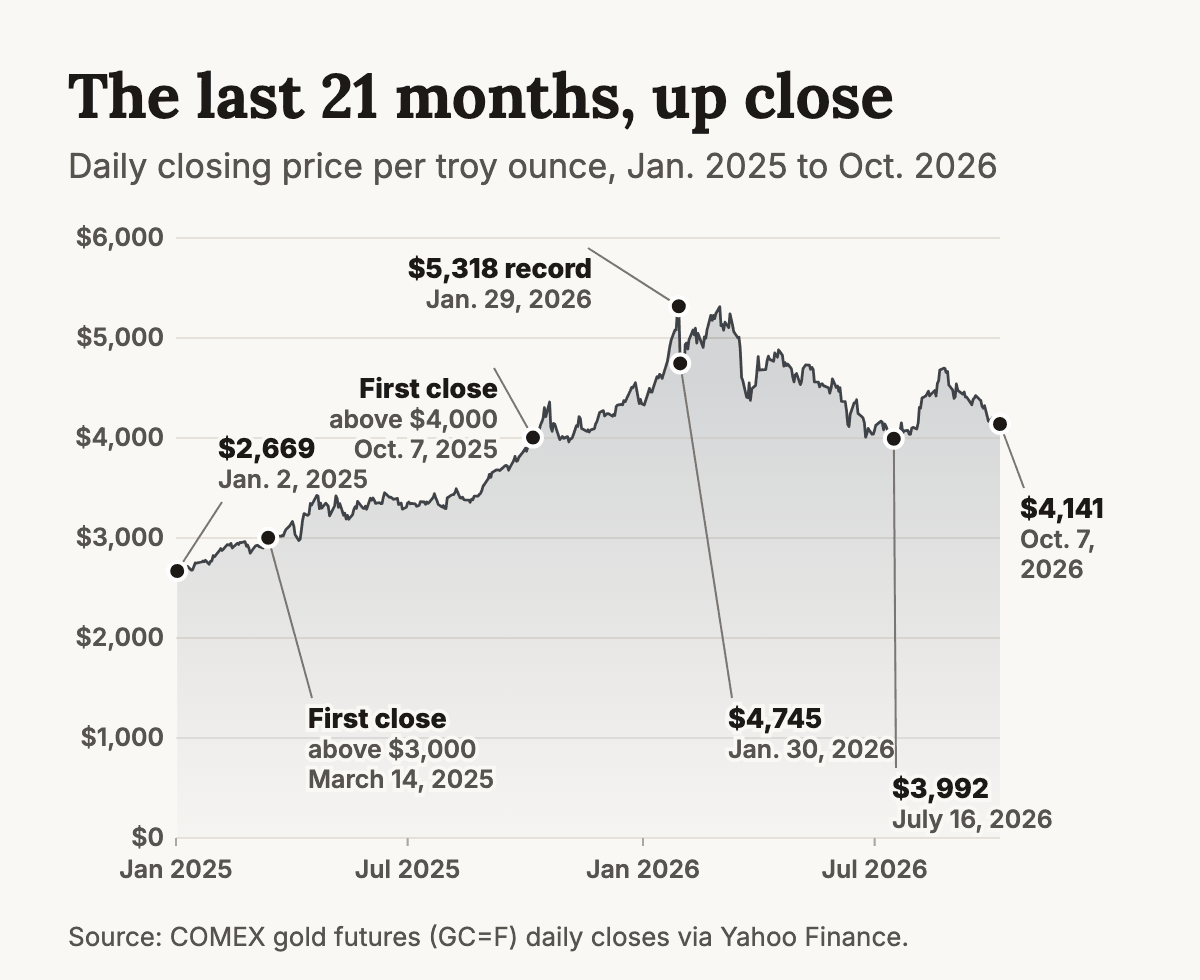
In thirteen months, gold nearly doubled. Then, in under six months, it gave back a quarter of its value. For a metal that many people buy precisely because it is steadier than shares, that is a reminder that "steadier" is relative.
It is worth comparing this with silver over the same months. Silver fell 48% from its January record, roughly twice as far as gold. Gold's swings are large, but silver's are larger. Our guide on whether to buy silver now or wait runs the same tests on silver prices, and the results are quite different.
Reasons people give for buying now
These are the arguments you will hear for buying at today's price. None is a guarantee, and each has some merit.
- Gold is about 22% below its record. For anyone who considered buying at $5,000, $4,140 looks like a markdown on the same metal.
- The long-run direction has been up. Over 26 years, gold went from under $300 to over $4,000. Short-term falls have so far been interruptions in that climb, not the end of it, though the past does not promise the future.
- Waiting can cost you. Gold last closed below $3,000 on April 8, 2025. Anyone who decided then to wait for a lower price has not had one since, and has watched the price rise by more than a third.
- Gold is widely held for protection, not profit. People buy it as a hedge against a weaker dollar, against inflation, or against a crisis in the financial system. If that is your reason, the purchase price is a smaller part of the decision than having some gold in place before you need it.
- Central banks have been buying. Purchases by central banks are often cited as one reason for gold's recent strength. That is demand that does not depend on what individual buyers do, though it can change.
Reasons people give for waiting
The arguments for holding back are just as worth hearing.
- Gold can fall for years. After its 2011 peak, gold fell 44% and took almost nine years to recover. A 22% fall from a record says nothing about whether the fall has finished.
- The price has moved a long way, fast. Even after the pullback, gold is up 55% since the start of 2025. Big run-ups have been followed by long pauses before, as in 2011.
- You may need the money. Gold pays no interest and no dividends. Money set aside for the next couple of years, an emergency fund, or high-interest debt is usually better left where it is.
- You have not compared prices yet. The premium a dealer charges, and what it will pay to buy the gold back, can vary by more than gold moves in a typical month. Taking a week to get two written quotes is careful buying, not market timing.
- You do not know where it will be stored. Gold is compact, but it still needs a safe, a bank box or a depository, and insurance that covers it.
Look at the second list again. Most of it is about your circumstances, not about the gold market. That is often where the real answer lies.
What 26 years of gold prices say about timing
We ran three tests on the same daily closing prices used in the charts. They describe what happened between 2000 and 2026. They cannot tell you what happens next, but they do show how the urge to wait for a better price would have played out.
Test 1: one purchase or twelve
For every month from January 2001, we compared a buyer who spent everything on the first trading day with a buyer who spent the same total in twelve equal monthly purchases from that day.
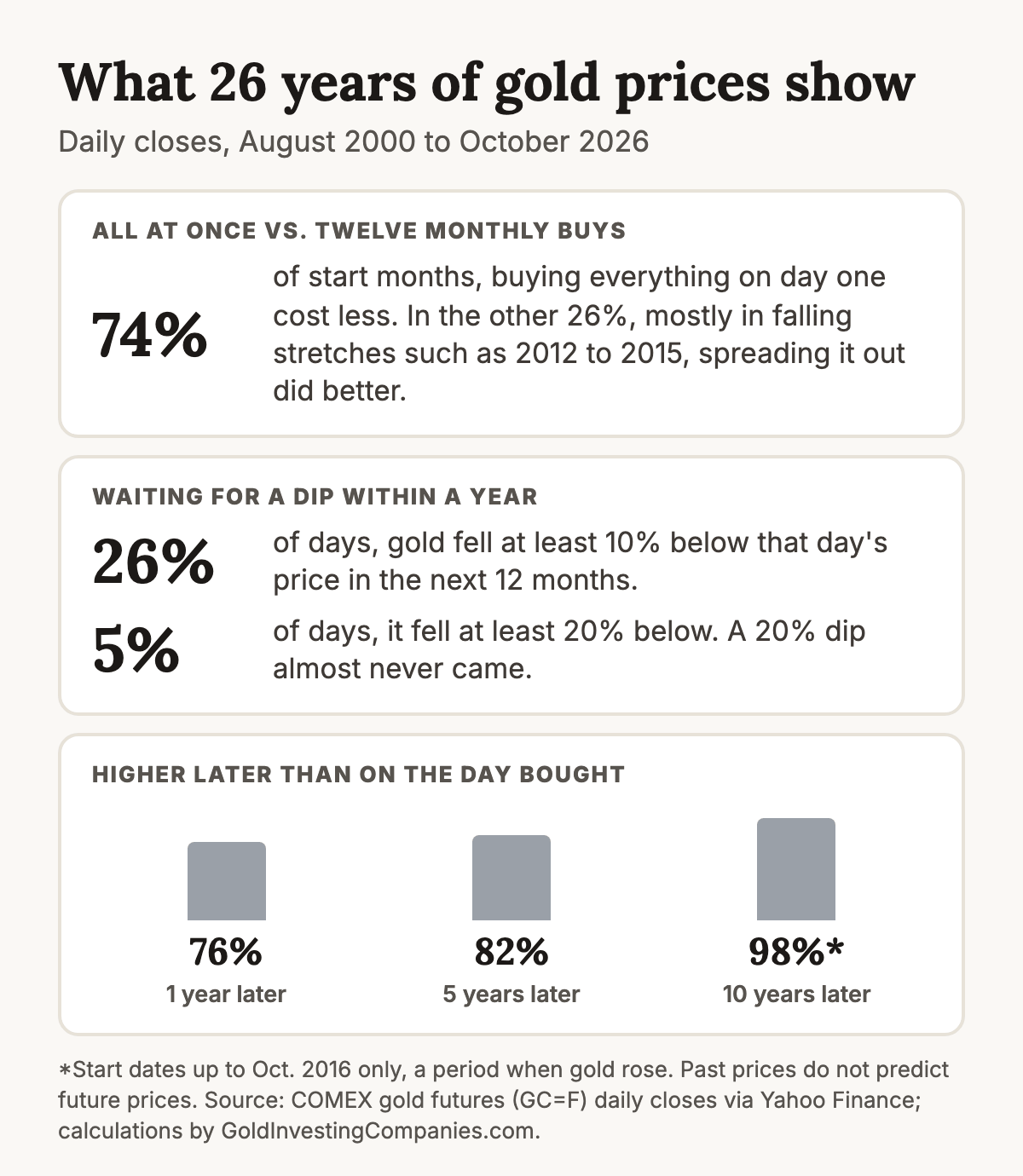
The one-time buyer paid less on average in 221 of 299 start months, or 74%. Because gold rose over most of the period, getting the money in early usually paid.
The other 26% were not spread at random. They cluster in the stretches when gold was falling or going nowhere: much of 2008, late 2011 through mid-2015, 2018, and the months after the August 2020 high. Those are exactly the moments when buying everything at once felt worst, and spreading purchases out softened the blow.
Test 2: waiting for a dip
For every trading day from 2001 to October 2025, we checked how far gold fell below that day's price in the following year.
- A dip of at least 5% came within a year on 48% of days.
- A dip of at least 10% came on 26% of days.
- A dip of at least 20% came on just 5% of days.
In other words, waiting for a small dip was a coin toss, waiting for a 10% dip failed three times in four, and waiting for a 20% dip almost never worked. On the days the dip did not come, the person waiting either paid a higher price later or stayed on the sidelines.
Test 3: was gold higher later?
We compared each day's price with the price one, five and ten years later.
| Held for | Gold higher at the end |
|---|---|
| One year | 76% of start days |
| Five years | 82% of start days |
| Ten years | 98% of start days, see the note below |
The ten-year figure needs care. It can only include start dates up to October 2016, and the decade that followed was very strong for gold. The 2% of start dates that were lower after ten years all fall between August 2011 and November 2012, near the old peak. Over five years, gold was lower at the end nearly one time in five.
Putting the three together
The data leans against waiting. Holding off for a lower price rarely paid, and an early single purchase usually beat a slow one. But the exceptions were concentrated around peaks, and they were long. If today turns out to resemble 2011, someone who puts everything in at once could wait years to see this price again. That is why many buyers choose a middle course.
How to buy without needing to time it
If you have decided that owning gold suits you but you are torn about the moment, these are three ways buyers get past it.
Buy in equal installments. Choose a total, split it into equal amounts, and buy one amount on a fixed schedule, for example monthly for six or twelve months. This is usually called dollar-cost averaging. It will not get you the lowest price, but it will not get you the highest either, and it removes the pressure of picking a day. Check the costs first: small orders can carry a higher premium per ounce, and shipping and insurance are charged per order, so ask the dealer what each order size costs.
Split the purchase. Buy part now and set a date, not a price, for the rest. A date-based plan avoids the trap of waiting for a dip that, as the tests show, rarely arrives.
Size the purchase to survive a slump. If you prefer one purchase, make it an amount you could hold calmly through a 44% fall and a nine-year wait, the worst stretch in our series. A purchase you can hold through a bad patch is one you will not be forced to sell at the bottom.
In every case, write the plan down. It is far easier to follow a decision made on a quiet day than to make one on a day when gold has just moved $200.
Questions to settle first
These questions usually decide whether you should buy, and how much, better than any price forecast.
- What do I want gold to do for me? Hold value over a long period, hedge against a crisis, diversify retirement savings, or make a quick gain? The last is the reason most likely to end in disappointment.
- How much of my savings is that? Decide on a share you would be comfortable seeing fall by a third or more for several years.
- When will I need the money? If the answer is soon, gold's swings make it a poor home for it.
- Outright or in an IRA? Physical gold in your own hands, or gold held for you in a retirement account. The rules differ, as explained below.
- Coins or bars? Government-minted coins are easy to sell and widely recognized. Bars usually cost less per ounce. Collectible coins carry high markups and are best avoided if you are buying for the gold.
- Who will I buy from? Get written quotes from at least two dealers for the same items, with the price per ounce and the buyback price.
If you cannot yet answer the first three, waiting is the right decision for you, whatever the market does.

Things that matter more than the day you buy
The premium over spot. No one buys physical gold at the spot price. You pay spot plus a premium, which varies by product and by seller. A difference in premium can easily outweigh a few days of price movement, so compare the delivered price per ounce, not the headline number.
The buyback price. Ask every dealer what it would pay today to buy back the exact items you are buying. The gap between that and your purchase price is your real cost of owning gold, and it is the number many buyers never ask about.
Where it is kept. At home, you need a proper safe and insurance that covers bullion; many home policies limit it. A bank safe deposit box is secure, but its contents are not covered by FDIC insurance. A private depository is insured and is the only option for gold in an IRA.
Tax when you sell. The IRS treats gold coins and bullion as collectibles and says net capital gains from selling collectibles are taxed at a maximum rate of 28%. Keep every invoice. This is general information, not tax advice.
The seller's honesty. Gold offered well below the market price, pressure to decide on the phone, and pitches for rare or "exclusive" coins are bigger dangers than any market move. Our guide to gold bar scams and our gold scammer list show what to watch for.
Buying gold outright or in a gold IRA
Outright purchase. You buy with your own money, and the gold is delivered to you or to a depository. You choose any form, keep it where you like, and can buy in installments easily. Some banks also sell gold coins; our list of banks that sell gold coins covers which ones.
Gold IRA. A self-directed IRA owns the gold, usually funded by moving money from an existing IRA or 401(k). The gold must be at least 99.5% pure, with an exception for the American Gold Eagle, and must be held by an approved depository, never at home. Because the money often arrives in one transfer, the gold is usually bought in one go, though you can leave part of the balance in cash inside the account and buy more later.
If you are considering an IRA, start with our guide to the gold IRA rollover, then weigh the gold IRA pros and cons. Our ranking of the best gold IRA companies compares three dealers in detail.
Where to buy when you are ready
Whenever you buy, buy from an established company with a long public record. The three we compare on this site all sell gold for delivery and for retirement accounts, and each offers a free guide. Requesting one costs nothing and does not commit you to anything.
- Augusta Precious Metals sells gold and silver for cash and for IRAs, explains the process in detail before any sale, and asks for a minimum of $50,000. It is our first-ranked company.
- Goldco sells gold and silver for IRAs and for direct purchase, has the most specific written buyback policy of the three, and currently advertises a free silver promotion on qualifying orders.*
- American Hartford Gold sells gold, silver and platinum, ships insured to your door for a delivery order, and publishes a $10,000 minimum for an IRA.
If you decide to wait, reading these guides is a good way to spend the time. Our article on the free gold IRA kit describes what is in them.
Claim Augusta's Free Gold IRA Kit
Claim Goldco's Free Gold IRA Kit
Claim American Hartford Gold's Free Guide
Mistakes buyers make with timing
- Waiting for a particular price. A 20% dip within a year happened on only 5% of days in our series.
- Buying in a rush after a big rise. Headlines and adverts are loudest near peaks, as in August 2011 and January 2026.
- Selling in a panic after a fall. The people hurt worst by the 2011 to 2015 slide were those who sold near the bottom.
- Using money you will need soon. Gold has gone years without regaining a high.
- Watching the spot price and ignoring the premium. Compare the delivered price per ounce and the buyback price.
- Paying for rarity instead of gold. Collectible coins carry markups far above the metal.
- Skipping the plan. Decide the amount, the schedule and the seller in advance.
FAQ
Is now a good time to buy gold?
No one can know for sure. On October 7, 2026, gold closed at $4,140.70, about 22% below its January 2026 record and about 15 times its price in 2000. Your reasons for buying, the amount and when you might need the money matter more than today's price.
Will gold go down more?
It may. Gold fell 44% from its 2011 peak and took almost nine years to recover. In our series, though, a further fall of 20% within a year happened from only 5% of starting days. Plan for both possibilities.
Is it better to buy gold all at once or over time?
In our test since 2001, one purchase beat twelve monthly purchases in 74% of start months. Spreading purchases out did better mainly when gold was falling, such as 2012 to 2015. Many buyers spread purchases out to avoid putting everything in at a peak.
What is the highest gold price ever?
In the COMEX futures series on this page, the record daily close was $5,318.40 an ounce, on January 29, 2026. Spot prices from other sources can differ slightly, and prices traded higher within some days.
How long did gold take to recover after 2011?
Gold closed at $1,888.70 on August 22, 2011, and did not close above that level again until July 23, 2020, almost nine years later.
Should I wait for gold to drop before buying?
History says the wait is usually long or endless. Within a year, a 10% dip came from about a quarter of starting days, and a 20% dip from one in twenty. If you want to wait, set a date to decide rather than a price.
Is gold safer than silver right now?
Gold has been the steadier of the two. From their January 2026 records, gold fell about 22% and silver about 48%. Both can fall, and neither pays interest. Our gold IRA vs silver IRA guide compares them.
Is buying gold right for me?
That depends on your circumstances, which a website cannot judge. Gold pays no income and its price can fall for long periods. Speak with a licensed financial professional who is not paid on the sale.
The bottom line
Gold's history makes a fairly clear point about timing: waiting for a lower price has usually cost buyers more than it saved, yet the exceptions, around the 2011 peak, were painful and long. You cannot know which kind of moment today is.
So set the timing question aside and answer the ones you can. Decide whether gold fits your situation, choose an amount you could hold through a long slump, decide between buying outright and an IRA, compare two written quotes, and if you are still uneasy, buy in installments on a fixed schedule. That plan has held up through every stretch on the chart.
Sources
- Gold prices: COMEX gold futures (GC=F) daily closes from Yahoo Finance, August 30, 2000 to October 7, 2026. The three timing tests were calculated by us from that series. Futures closes can differ slightly from spot prices.
- IRS Topic 409: capital gains and losses
- IRS: frequently asked questions about IRAs
- Each company's own website, as read for our company reviews in October 2026.
Claim Augusta's Free Gold IRA Kit
*Applies only to qualified orders. Get up to 5% back in FREE Silver when you purchase $50,000 - $99,999. Get up to 10% in FREE Silver when you purchase $100,000 or more. Cannot be combined with any other offer. Additional rules may apply. Contact your representative to find out if your order qualifies. For additional details, please see your customer agreement. Goldco does not offer financial or tax advice.
More guides
 Gold
GoldGold Bar Scams: How They Work and How to Avoid Them
The gold bar scams the FBI and FTC are warning about, from fake agents and couriers to counterfeit bars, with the warning signs and how to buy a bar safely. Gold
GoldUpdated Gold Scammer List for 2026
The gold dealers named in real regulatory actions and court judgments, the tactics they used, and how to check any gold company before you buy. Gold
GoldList of Banks That Sell Gold Coins
Most big U.S. banks don't sell gold coins. See which banks still do, what they actually offer, the trade-offs, and where most buyers go instead.Looking for a company to buy from? See how Augusta Precious Metals, Goldco and American Hartford Gold compare.
Compare the three companies