Gold IRA
Gold IRA Rollover: How It Works, Rules and Steps
A gold IRA rollover moves money from a retirement account you already have, such as a 401(k) or an IRA, into a self-directed IRA that holds physical gold. Done the right way, no tax is due and nothing is withheld. Done the wrong way, the IRS can treat the whole amount as a withdrawal.
The difference comes down to how the money travels. This guide explains the three ways to move it, the IRS rules and deadlines that apply, which accounts qualify, and the steps from first call to gold in the vault.
The short version: ask for a direct transfer, so the money goes from one institution to the other and never passes through your hands. That one choice avoids the 60-day deadline, the withholding and the once-a-year limit. The rest of this page explains why.
This is general information, not tax advice. The rules below come from the IRS pages linked at the end, read on October 2, 2026. Confirm how they apply to you with a tax professional before you move money.
What a gold IRA rollover is
A gold IRA is a self-directed individual retirement account. It follows the same tax rules as any other IRA, but it can hold physical gold and other approved metals, which an ordinary brokerage IRA cannot.
You can fund one with new contributions, but most people fund it with savings they already have in another retirement account. Moving that money across is what people mean by a gold IRA rollover. The gold itself is bought after the money arrives.
Three parties are involved once the new account exists:
- The custodian holds the IRA, receives the money and reports to the IRS.
- The gold IRA company is the dealer that sells you the coins and bars.
- The depository stores the metal. IRA gold cannot be kept at home.
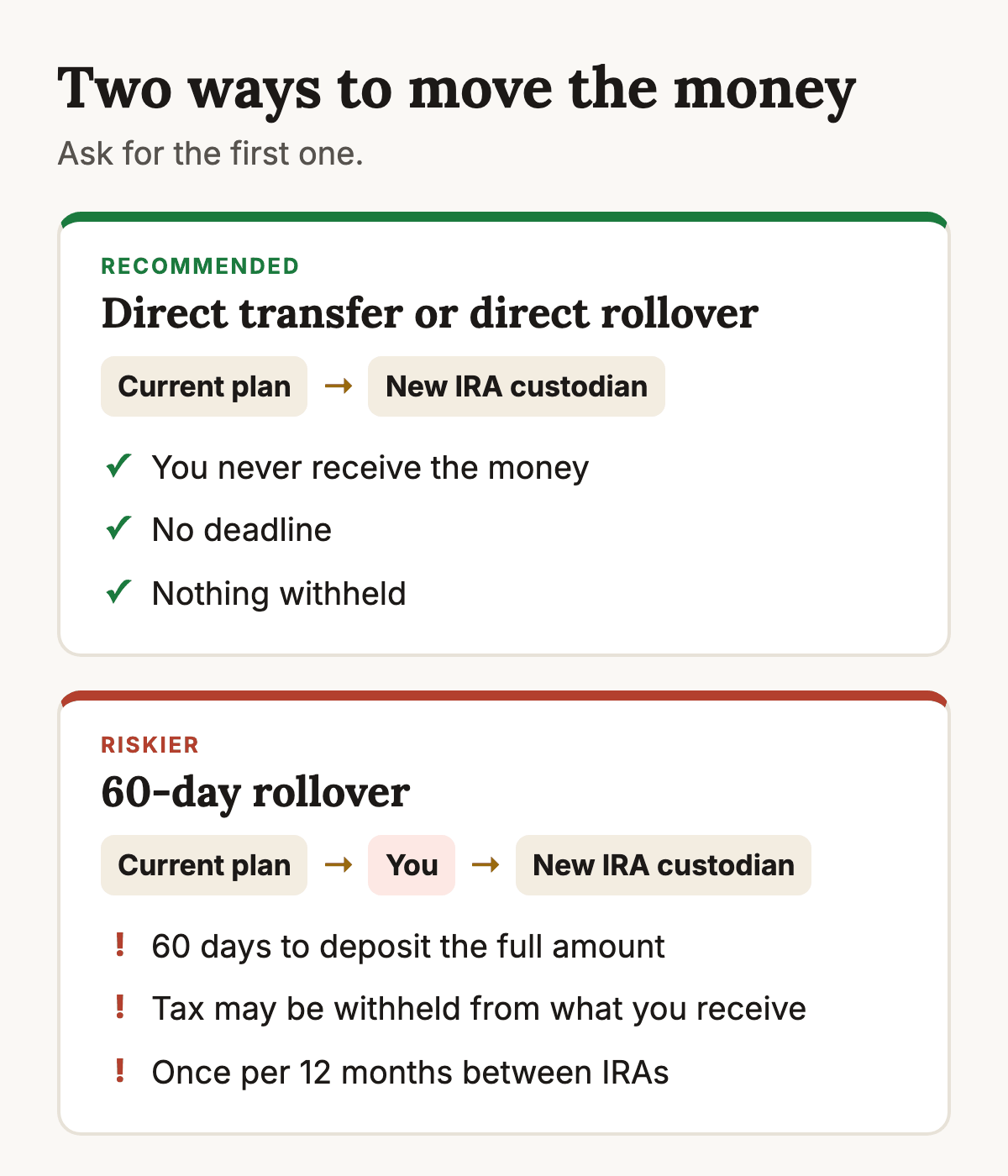
Rollover or transfer: three ways to move the money
People use "rollover" for all of these, but the IRS describes three different methods, and they are not treated alike.
| Method | What happens | Deadline | Withholding |
|---|---|---|---|
| Trustee-to-trustee transfer | Your current IRA custodian sends the money straight to the new IRA custodian | None | None |
| Direct rollover | Your employer plan sends the money straight to the new IRA | None | None |
| 60-day rollover | The money is paid to you, and you deposit it into the new IRA yourself | 60 days | Yes, see below |
The first two are the same idea. One starts from an IRA and the other from an employer plan such as a 401(k). In both, the money moves between institutions and you never receive it. Gold companies often call either of these a "direct rollover" or simply a "transfer".
The third is the one that causes problems. It is sometimes called an indirect rollover.

The IRS rules that matter
The 60-day deadline
If a distribution is paid to you, the IRS gives you 60 days from the date you receive it to deposit it into another plan or IRA. Miss the deadline and the amount is generally taxable. If you are under 59½, the 10% additional tax on early distributions may apply as well, unless you qualify for an exception.
Withholding
When money is paid to you first, some of it is held back for tax.
- From an employer plan, the IRS says a distribution paid to you is subject to mandatory withholding of 20%.
- From an IRA, a distribution paid to you is subject to 10% withholding unless you elect out.
This is the trap in a 60-day rollover from a 401(k). Suppose your plan pays out $100,000. You receive $80,000, because $20,000 is withheld. To roll over the full $100,000, you must deposit $100,000 within 60 days, which means finding the missing $20,000 from other money. Deposit only the $80,000 you received and the other $20,000 is treated as a distribution.
A direct rollover or transfer has no withholding, so the problem never arises.
The one-rollover-per-year rule
The IRS allows only one rollover from an IRA to another IRA in any 12-month period. That limit applies to 60-day rollovers between IRAs. It does not apply to trustee-to-trustee transfers, or to rollovers from an employer plan to an IRA.
What cannot be rolled over
Some payments are not eligible at all. The IRS list includes required minimum distributions, hardship distributions, and loans treated as distributions. If you are at the age where required minimum distributions apply, that year's required amount has to come out before the rest can move.
Moving traditional money into a Roth
Money normally stays the same type when it moves: traditional to traditional, Roth to Roth. Moving traditional savings into a Roth gold IRA is a conversion, and the amount converted is taxable in the year you do it.
Which accounts can be rolled into a gold IRA
In general, these can be moved:
- a traditional IRA or Roth IRA;
- a SEP or SIMPLE IRA, subject to its own rules;
- a 401(k), 403(b) or governmental 457(b) from a former employer;
- a Thrift Savings Plan.
An account with your current employer is different. Many plans do not let you move money out while you still work there, or only allow it after a certain age. The plan's own rules decide, so ask your plan administrator before you start.
You do not have to move everything. The IRS lets you roll over all or part of a distribution, and many savers move only a portion of their balance into metals.
How to do a gold IRA rollover, step by step
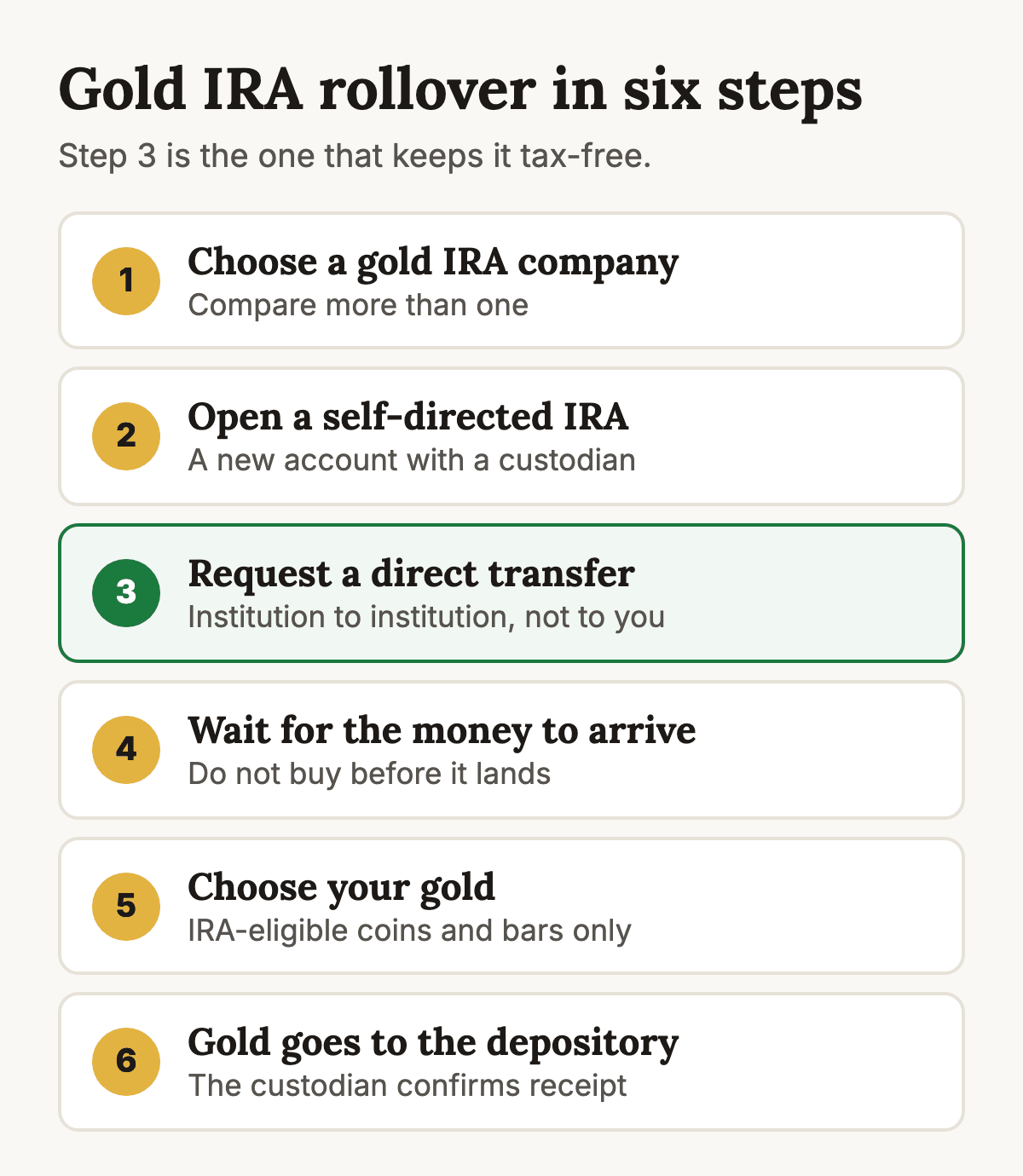
- Choose a gold IRA company. The company guides the process and sells you the metal. Compare more than one. Our guide to the best gold IRA companies ranks three on their public records.
- Open a self-directed IRA. The company helps you apply to a custodian. This is a new, empty account.
- Request a direct transfer or direct rollover. You, or the new custodian on your behalf, ask your current custodian or plan administrator to send the money straight to the new IRA. Ask for it in exactly those words.
- Wait for the money to arrive. How long this takes depends mostly on your current provider. Ask both sides for an estimate, and do not buy anything until the money has landed.
- Choose your gold. You pick IRA-eligible coins and bars. Before you approve the order, ask what you will pay per item and what the company would pay to buy the same item back today.
- The gold goes to the depository. The dealer ships it there, and the custodian confirms it has been received.
If your current plan insists on sending a check, ask for it to be made payable to the new custodian for the benefit of your IRA, not to you personally. A check made out that way is still a direct rollover.
What gold you can hold
The rollover is only half the job. The money has to be spent on metal the IRS allows.
- The IRS does not permit IRAs to hold collectibles, and most coins and metals count as collectibles. There is an exception for certain highly refined bullion and for certain coins.
- Gold must be at least 99.5% pure. The American Gold Eagle is allowed by a specific exception.
- The bullion has to be in the physical possession of a bank or an IRS-approved nonbank trustee. Keeping it at home does not meet the rule.
If an IRA buys a collectible, the IRS treats the amount as distributed in that year, and the 10% additional tax may apply. This is why rare and "exclusive" coins have no place in a retirement account, whatever a salesperson says. Our gold scammer list has documented cases of dealers who pushed them.
Mistakes to avoid
- Taking the check yourself. A 60-day rollover adds a deadline and withholding for no benefit.
- Rolling over twice in a year. A second 60-day rollover between IRAs within 12 months breaks the once-a-year rule.
- Assuming your current 401(k) can move. Check with the plan first.
- Buying before the money arrives. Prices are confirmed when the order is placed, not when you first call.
- Buying collectibles. Stick to standard bullion that meets the purity rule.
- Storing the gold at home. It ends the tax protection.
- Deciding on the first call. Ask for the company's guide and read it first. Our article on the free gold IRA kit explains what these guides contain.
Choosing a company to help
Every gold IRA company handles rollover paperwork, so compare them on what differs: how long each has been in business, its Better Business Bureau record, how much it asks you to start with, and what it puts in writing about buying your gold back.
On this site we compare three. Augusta Precious Metals asks for $50,000 and leads with education. American Hartford Gold publishes a $10,000 minimum for an IRA. Goldco does not publish a minimum and has the most specific buyback wording. The full comparison is in our ranking, and whether a gold IRA is a good idea at all is covered in gold IRA pros and cons.
FAQ
Is a gold IRA rollover taxable?
Not when it is done as a direct transfer or direct rollover between accounts of the same type. A 60-day rollover is also tax-free if you deposit the full amount in time. Moving traditional money into a Roth account is a taxable conversion.
What is the 60-day rule?
If a retirement distribution is paid to you, the IRS gives you 60 days from the day you receive it to deposit it in another plan or IRA. After that it is generally taxable.
Can I roll over my 401(k) while I am still working?
Sometimes. It depends on your plan. Many plans do not allow it until you leave the employer or reach a certain age. Ask your plan administrator.
How many rollovers can I do in a year?
Only one 60-day rollover from an IRA to another IRA in any 12-month period. Direct trustee-to-trustee transfers are not limited, and neither are rollovers from an employer plan to an IRA.
Is there a limit on how much I can roll over?
No. Rollovers are not subject to the annual IRA contribution limit, and you can roll over all or part of a balance. A gold IRA company may set its own minimum.
Can I roll over into gold I keep at home?
No. IRA bullion must be held by a bank or an IRS-approved trustee. Gold kept at home is treated as taken out of the account.
What does a gold IRA rollover cost?
We do not publish cost figures, because the numbers found online are often wrong. The custodian and the depository each charge separately from the dealer. Ask for every charge in writing before you move money.
Do I need a gold IRA company to do a rollover?
You need a custodian for the account and a dealer for the metal. A gold IRA company acts as the dealer and usually guides the paperwork with the custodian, which is why most people go through one.
The bottom line
A gold IRA rollover is simple when the money moves directly between institutions. Ask for a direct transfer or direct rollover, confirm your current plan allows it, wait for the money to arrive, and buy only standard bullion that the IRS permits. The companies that do this every day will handle the forms. Your part is to choose the company carefully and get the prices in writing.
Sources

More guides
 Gold IRA
Gold and Silver IRA Accounts: How They Work
How a gold and silver IRA account works: holding both metals in one account, what each must meet, how people divide them, storage, and who offers them. Gold IRA
Goldco vs Augusta Precious Metals: Which Is Better?
Goldco vs Augusta Precious Metals compared for 2026: ratings, minimums, buyback, storage and free kits, and which gold IRA company suits which buyer. Gold IRA
Goldco vs American Hartford Gold: Which Is Better?
Goldco vs American Hartford Gold compared for 2026: ratings, minimums, buyback, storage and free guides, and which gold company suits which buyer.Looking for a company to buy from? See how Augusta Precious Metals, Goldco and American Hartford Gold compare.
Compare the three companies