Gold IRA
Gold and Silver IRA Accounts: How They Work
You do not need two retirement accounts to own both gold and silver. A single self-directed IRA can hold both metals side by side, along with platinum and palladium if you want them. Many people who look into a "gold IRA" end up asking whether to add silver, and a combined account is how that is done.
This guide explains how a gold and silver IRA account works, what each metal has to meet to be allowed, the ways people divide the account between the two, how storage works with two very different metals, and what to ask the companies that offer these accounts.
The short version: open one self-directed IRA, fund it by moving money directly from an existing retirement account, and buy only bullion that meets the IRS rules for each metal. Decide how you want to split it before you call anyone, and ask how storage is charged for silver, which takes up far more room than gold.
This is general information, not advice about what to buy. The IRS rules mentioned here come from the IRS page linked at the end, and company facts were read from each company's own website on October 3, 2026.
Claim Free Gold & Silver IRA Kit
What a gold and silver IRA account is
It is a self-directed individual retirement account that owns physical precious metals. "Self-directed" is what makes it possible: an ordinary brokerage IRA can hold funds and shares, but not coins and bars. The tax rules are those of any IRA. A traditional account is funded with pre-tax money and taxed on withdrawal; a Roth account is funded with after-tax money, and qualified withdrawals are tax-free.
Nothing in the rules forces you to choose one metal. The same account can hold gold coins, silver bars and anything else that qualifies, in any proportion, and you can change the mix later by selling one metal and buying another inside the account.
Three parties run it for you:
- the custodian, which holds the account and reports to the IRS;
- the dealer, the gold and silver IRA company that sells you the metal;
- the depository, which stores it. IRA metals cannot be kept at home.
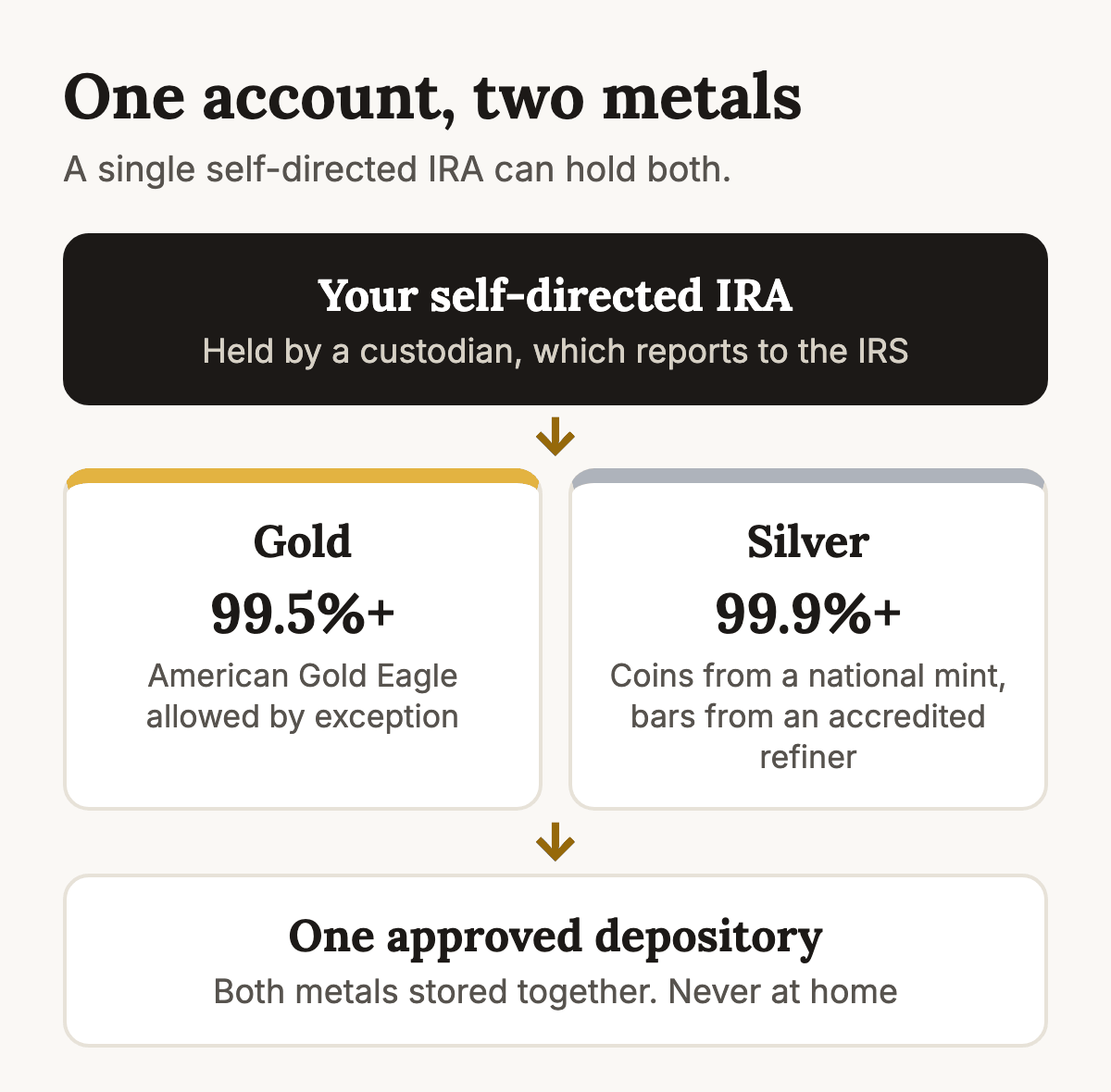
What each metal must meet
The IRS does not allow IRAs to own collectibles, and most coins and metals count as collectibles. Precious metals get in only through a narrow exception for highly refined bullion and certain coins, held by a bank or an IRS-approved nonbank trustee. In practice, the standards look like this.
| Gold | Silver | |
|---|---|---|
| Minimum purity | 99.5% | 99.9% |
| Notable exception | The American Gold Eagle is allowed although it is 91.67% gold | None needed: the American Silver Eagle is .999 |
| Typical coins | American Gold Eagle, American Gold Buffalo, Canadian Gold Maple Leaf | American Silver Eagle, Canadian Silver Maple Leaf |
| Bars | From an accredited refiner, with weight and purity stamped | From an accredited refiner, with weight and purity stamped |
| Not allowed | Rare and collectible coins, South African Krugerrands, jewelry | Rare and collectible coins, older 90% silver coins, jewelry and silverware |
Platinum and palladium bullion also qualify, at the very high purity the rules require. Some gold and silver IRA companies sell them, though few buyers hold much of either.
If an IRA buys something that does not qualify, the IRS treats the amount as distributed in that year. Tax is due, and if you are under 59½ the 10% additional tax may apply. A dealer pushing "exclusive" or "limited" coins for a retirement account is the warning sign to watch for. Our gold scammer list shows how regulators have dealt with dealers who did that.

Why people hold both
Gold and silver are both precious metals, but they do not behave the same way.
- Gold is the steadier of the two. Its price is driven mostly by its role as a store of value and by central bank and retail demand.
- Silver is more volatile, rising and falling more sharply. A large share of silver goes into industrial uses, so it also reacts to economic activity in a way gold does not.
- Silver costs far less per ounce, so the same money buys many more ounces, in smaller units that are easier to sell a little at a time.
Holding both gives an account some of each character. Whether that suits you depends on your circumstances, and it is a question for a licensed financial professional, not a website. Our comparison of a gold IRA vs. a silver IRA goes into the differences in more depth.
How people divide the account
There is no correct split, and no rule requires one. The approaches people use tend to fall into three groups.
- Mostly gold, some silver. Gold forms the core, and silver is a smaller addition.
- An even split. Roughly equal amounts by value.
- Mostly silver. Less common, chosen by people who are comfortable with bigger price swings.
Two practical points apply whichever you choose. The split is by value, not by weight: an even split by value means many times more silver than gold by weight. And the balance drifts as prices move, so some people rebalance from time to time by selling one metal and buying the other. Because that happens inside the IRA, it is not a taxable event.
Opening and funding the account
- Choose a company. It helps you open the account with a custodian and sells you the metals.
- Open a self-directed IRA. One account is enough for both metals.
- Fund it. Most people move money from an existing IRA, 401(k), 403(b) or Thrift Savings Plan. Ask for a direct transfer or direct rollover, so the money goes straight to the new custodian and never to you. Our guides to the gold IRA rollover and the silver IRA rollover explain the IRS rules.
- Choose your metals. Tell the company the split you want, and ask for the price per ounce and the buyback price of each item, in writing.
- The metals ship to the depository, and the custodian confirms they have arrived.
You can buy gold first and add silver later, or the other way round. The account does not need to hold both from the start.

Storing two metals
Both metals normally go to the same depository, under the same account.
What differs is the space they take. For the same amount of money, silver occupies many times the room of gold and weighs far more. If your account holds a lot of silver, storage is a bigger consideration than it would be with gold alone, so ask each company exactly how storage is charged for silver and for gold, and get the answer in writing.
You will also be offered a choice of storage type:
- commingled, where your metal is pooled with other clients' metal of the same kind and you receive equivalent pieces back;
- segregated, where your own coins and bars are kept apart and returned to you.
Both are legitimate. Ask which one a quote assumes.
Taking metal out later
When you take distributions, either by choice or because required minimum distributions begin on a traditional account, you can sell metal inside the IRA and take cash, or take the metal itself as an in-kind distribution, taxed on its value at the time.
Holding both metals helps here. Silver comes in smaller units, which makes it easier to take out exactly the amount you need. Keeping some coins or small bars in the account, alongside any larger bars, makes distributions simpler.
Who offers gold and silver IRA accounts
All three companies we compare on this site offer both metals in one account.
- Augusta Precious Metals offers gold and silver IRAs, names its custodian (Equity Trust Company) and depository (Delaware Depository) in advance, and leads with education. Its minimum is $50,000.
- Goldco offers gold IRAs and silver IRAs and gives silver equal billing. It has the most specific written buyback policy of the three, and it currently advertises a free silver promotion on qualifying orders.*
- American Hartford Gold lets you choose gold, silver or both, names its custodian (Equity Trust Company), lets you choose your depository, and publishes a $10,000 minimum for an IRA. It also sells platinum.
The full comparison is in our ranking, with more on silver in the best silver IRA companies.
Claim Augusta's Free Gold & Silver IRA Kit
Claim Goldco's Free Gold & Silver IRA Kit
Claim American Hartford Gold's Free Guide
Mistakes to avoid
- Opening two accounts when one will do. A single self-directed IRA can hold both metals.
- Buying junk silver or collectible coins. They are not allowed in an IRA.
- Splitting by weight instead of value. Decide the split in dollars.
- Ignoring storage for silver. Ask how it is charged before you choose a company.
- Letting the rollover pass through your hands. Use a direct transfer.
- Deciding on the first call. Read the company's guide first. Our article on the free gold IRA kit explains what these guides contain.
FAQ
Can one IRA hold both gold and silver?
Yes. A self-directed precious metals IRA can hold gold, silver, platinum and palladium in the same account, provided each meets the IRS rules.
What purity do gold and silver need for an IRA?
Gold must be at least 99.5% pure, with an exception for the American Gold Eagle. Silver must be at least 99.9% pure.
How should I split gold and silver in an IRA?
There is no rule. People commonly hold mostly gold with some silver, an even split, or mostly silver. The right mix depends on your circumstances, which a licensed financial professional can help you judge.
Can I change the mix later?
Yes. You can sell one metal and buy another inside the IRA, and because it happens inside the account it is not a taxable event.
Do gold and silver have to be stored separately?
No. Both are usually held at the same depository under the same account. You can choose commingled or segregated storage.
Can I keep my IRA gold and silver at home?
No. IRA metals must be held by a bank or an IRS-approved trustee. Keeping them at home is treated as taking them out of the account.
What does a gold and silver IRA cost?
We do not publish cost figures, because the numbers found online are often wrong. The custodian and the depository charge separately from the dealer, and silver can cost more to store because of its bulk. Ask for every charge in writing.
Is a gold and silver IRA right for me?
That depends on your circumstances, and a website cannot judge them. Neither metal pays interest or dividends, and both can fall in price. Speak with a licensed financial professional who is not paid on the sale.
The bottom line
A gold and silver IRA account is simply a self-directed IRA that holds both metals. One account is enough. Fund it with a direct transfer, buy only bullion that meets the purity rules for each metal, decide your split by value, and ask how storage works for silver before you choose a company.
Sources
- IRS: frequently asked questions about IRAs
- Each company's own website, read on October 3, 2026.
Claim Free Gold & Silver IRA Kit
*Applies only to qualified orders. Get up to 5% back in FREE Silver when you purchase $50,000 - $99,999. Get up to 10% in FREE Silver when you purchase $100,000 or more. Cannot be combined with any other offer. Additional rules may apply. Contact your representative to find out if your order qualifies. For additional details, please see your customer agreement. Goldco does not offer financial or tax advice.
More guides
 Gold IRA
Goldco vs Augusta Precious Metals: Which Is Better?
Goldco vs Augusta Precious Metals compared for 2026: ratings, minimums, buyback, storage and free kits, and which gold IRA company suits which buyer. Gold IRA
Goldco vs American Hartford Gold: Which Is Better?
Goldco vs American Hartford Gold compared for 2026: ratings, minimums, buyback, storage and free guides, and which gold company suits which buyer. Gold IRA
Gold IRA Rollover: How It Works, Rules and Steps
How a gold IRA rollover works: direct transfer vs 60-day rollover, the IRS rules and deadlines, which accounts qualify, and the steps to move money into gold.Looking for a company to buy from? See how Augusta Precious Metals, Goldco and American Hartford Gold compare.
Compare the three companies