Silver
Silver IRA Rollover: Rules, Steps and What to Buy
A silver IRA rollover takes money you already have in a retirement account and moves it into a self-directed IRA that owns physical silver. The tax rules are the same ones that govern any IRA move. What changes is everything that happens after the money arrives: which silver you are allowed to buy, how much room it takes to store, and how you will eventually take it out.
This guide covers both halves. First the move itself and the IRS rules that keep it tax-free, then the parts that are particular to silver.
The short version: have your current provider send the money directly to the new IRA custodian, never to you. Buy only silver that is at least 99.9% pure from a national mint or accredited refiner. Store it at an approved depository, and ask how storage is charged for silver before you choose, because silver takes up far more space than gold.
This is general information, not tax advice. The IRS rules below are from the pages linked at the end, read on October 2, 2026. Check your own situation with a tax professional before you move money.
How a silver IRA works
A silver IRA is a self-directed individual retirement account. It is taxed like any other IRA, traditional or Roth, but it can own physical silver, which a normal brokerage IRA cannot.
Three parties look after it:
- a custodian, which holds the account and reports to the IRS;
- a dealer, usually called a silver IRA company, which sells you the metal;
- a depository, which stores it. IRA silver cannot be kept at home.
Most silver IRAs are funded by moving savings from an existing account, because annual contribution limits are small compared with what people want to hold. That move is the rollover.
Moving the money without a tax bill
The IRS recognises three ways to move retirement money, and only one of them carries real risk.
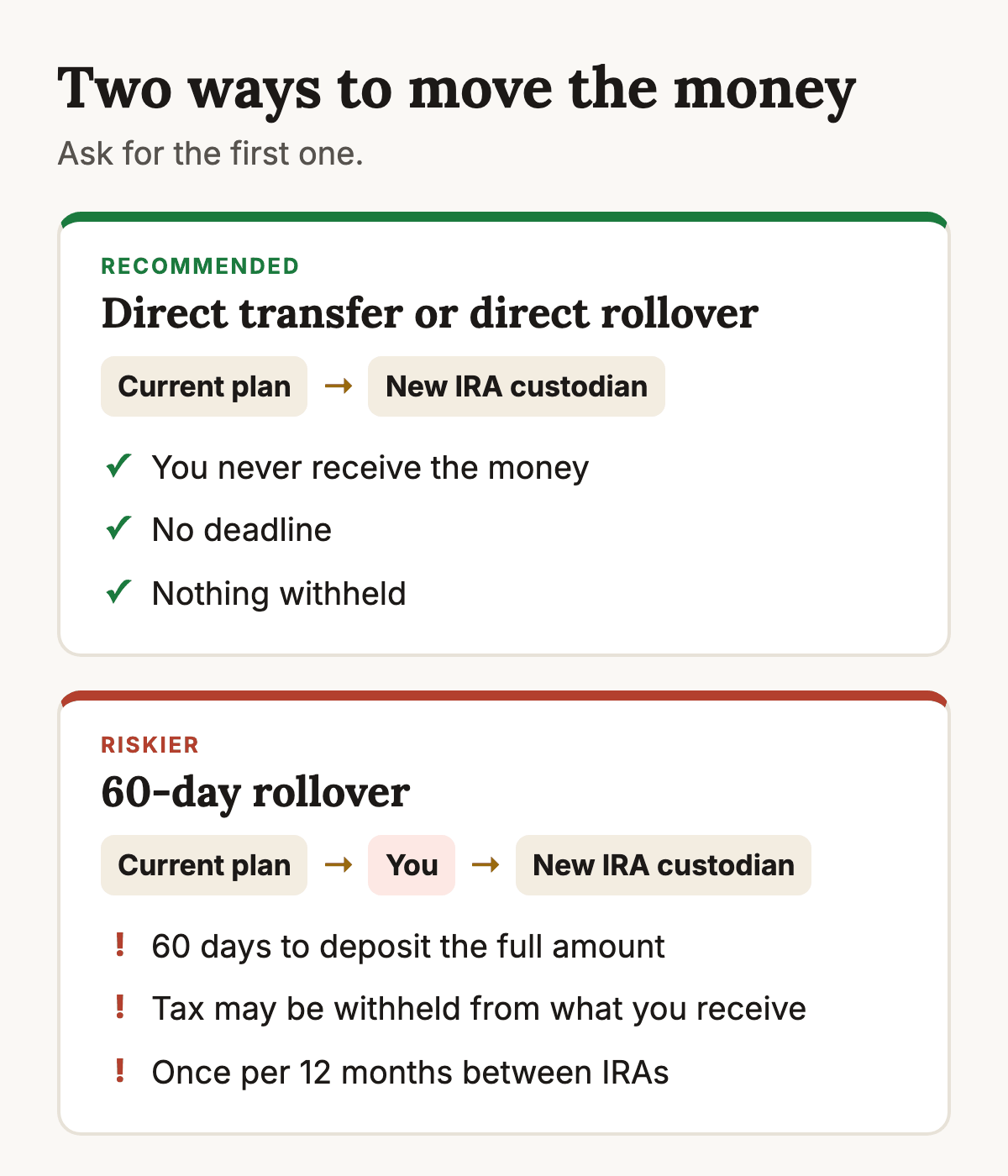
- Trustee-to-trustee transfer, from one IRA custodian straight to another.
- Direct rollover, from an employer plan such as a 401(k) straight to the new IRA.
- 60-day rollover, where the money is paid to you and you deposit it yourself.
The first two never put money in your hands, so there is no deadline, nothing is withheld and no tax is due. Silver IRA companies usually call either one a transfer.
The third is where people get caught. The IRS gives you 60 days from the day you receive a distribution to deposit it. If the money comes from an employer plan, 20% is withheld for tax before you get it, and from an IRA 10% is withheld unless you elect out. To complete the rollover you have to deposit the full original amount, which means making up the withheld part from other savings. Anything you do not deposit in time is generally taxable, and if you are under 59½ the 10% additional tax on early distributions may also apply.
Two more limits apply only to the 60-day route. You can make only one IRA-to-IRA rollover of this kind in any 12-month period. And some payments cannot be rolled over at all, including required minimum distributions and hardship distributions.
There is a fuller walk-through of these rules, with a worked example of the withholding, in our gold IRA rollover guide. They apply to silver in exactly the same way.

Which accounts can move into silver
Generally, you can roll into a silver IRA from:
- a traditional, Roth, SEP or SIMPLE IRA (a SIMPLE IRA has its own waiting rules);
- a 401(k), 403(b) or governmental 457(b) from an employer you have left;
- the Thrift Savings Plan.
A plan with your current employer may not allow money to leave while you still work there. The plan sets that rule, so ask the administrator first.
Keep the account type the same. Traditional money goes into a traditional silver IRA and Roth money into a Roth silver IRA. Moving traditional savings into a Roth is a conversion, and the converted amount is taxed that year.
You can move all of a balance or only part of it. Many people move a portion into metals and leave the rest where it is.

What silver you can buy
This is where a silver IRA differs from a silver purchase you keep at home. The IRS does not allow IRAs to own collectibles, and most coins and metals count as collectibles. Silver is allowed only under a narrow exception for highly refined bullion and certain coins.
In practice that means:
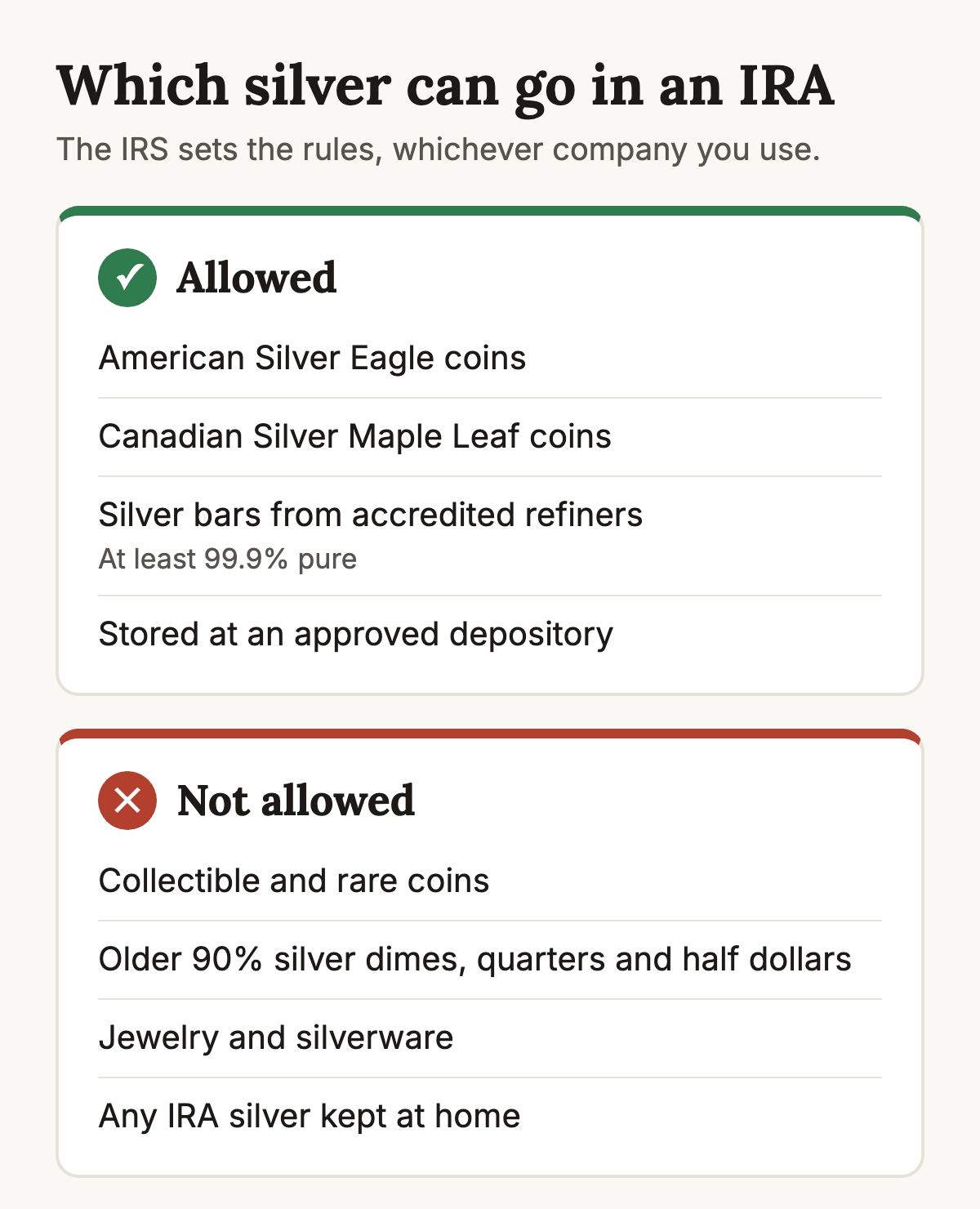
- purity of at least 99.9%;
- coins from a national mint, such as the American Silver Eagle and the Canadian Silver Maple Leaf;
- bars from an accredited refiner, with the weight, purity and refiner stamped on them;
- storage with a bank or an IRS-approved nonbank trustee.
Older U.S. dimes, quarters and half dollars made of 90% silver do not qualify, however much silver they contain. Neither do rare or collectible coins, jewelry or silverware.
If an IRA buys something that does not qualify, the IRS treats the amount as distributed in that year, so tax is due, and the 10% additional tax may apply if you are under 59½. That makes the dealer's product list matter. A salesperson steering you toward "exclusive" or "limited" silver for a retirement account is a warning sign. Our gold scammer list has documented cases.
Coins or bars?
Both qualify, and the choice is the same trade-off as outside an IRA.
- Bars usually carry a smaller premium over the market price, so more of your money goes into metal. Larger bars are cheaper per ounce but cannot be sold in part.
- Coins cost more per ounce and are easier to sell in small amounts, which matters later when you start taking distributions.
Many silver IRAs hold mostly bars with some coins. Our guide to buying 1,000 ounces of silver compares the forms in more detail.
Why storage matters more with silver
For the same amount of money, silver takes up many times the space of gold and weighs far more. In a silver IRA that has two consequences.
Storage is a bigger part of the picture. Depositories charge to hold metal, and a large silver holding occupies more shelf than gold of the same value. Ask each company exactly how storage is charged for silver, and get it in writing.
The type of storage is worth choosing deliberately. Commingled storage pools your silver with other clients' metal of the same kind and returns equivalent pieces. Segregated storage keeps your own bars and coins apart. Both are legitimate. Ask which one a quote assumes.
You cannot avoid the depository by storing IRA silver yourself. The tax code requires a bank or approved trustee to hold it, and the U.S. Tax Court has treated IRA coins kept at home as distributed.
Taking silver out later
At some point you will take distributions, either because you want to or because required minimum distributions start. You have two choices.
- Sell some silver inside the IRA and take cash. This is where a dealer's buyback terms matter.
- Take the silver itself as an in-kind distribution. It is taxed on its value at the time, and it then belongs to you outright.
Smaller units make both easier, which is another reason to hold some coins or 10 ounce bars alongside larger bars.
Step by step
- Choose a silver IRA company, and compare more than one. Our ranking of the best silver IRA companies covers three.
- Open a self-directed IRA with a custodian. The company helps with the application.
- Ask for a direct transfer or direct rollover from your current provider to the new custodian. If a check must be issued, have it made payable to the new custodian for the benefit of your IRA.
- Wait for the money to arrive before buying anything.
- Choose IRA-eligible silver. Ask for the price per ounce and the buyback price of the exact items, in writing.
- The silver ships to the depository, and the custodian confirms it.
Mistakes to avoid
- Letting the money pass through your hands. A 60-day rollover adds a deadline and withholding for no benefit.
- Buying junk silver for an IRA. Older 90% silver coins are popular outside retirement accounts but are not allowed inside one.
- Choosing on the premium alone. A low price per ounce means little if storage for silver is charged heavily or the buyback price is poor. Compare all three in writing.
- Buying only large bars. They are cheapest per ounce, but a single large bar is awkward when you need to sell part of it or take a distribution.
- Assuming your current 401(k) can move. Check the plan's rules first.
- Deciding on the first call. Request each company's guide and read it before you commit. Our article on the free gold IRA kit explains what these guides contain, and the same applies to silver.
Choosing a company
All three companies we compare offer silver IRAs and handle the rollover paperwork.
- Augusta Precious Metals names its custodian and depository in advance and leads with education. Its minimum is $50,000.
- Goldco gives silver equal billing, has the most specific written buyback policy of the three, and currently advertises a free silver promotion on qualifying orders.*
- American Hartford Gold publishes a $10,000 minimum for an IRA and lets you choose your depository.
Claim Augusta's Free Silver IRA Kit
Claim Goldco's Free Silver IRA Kit
Claim American Hartford Gold's Free Guide
FAQ
Can I roll my 401(k) into a silver IRA?
Usually, if the 401(k) is from an employer you have left. A current employer's plan may not allow it. Ask for a direct rollover so the money goes straight to the new custodian.
Is a silver IRA rollover taxable?
Not when it is done as a direct transfer or direct rollover between accounts of the same type. A 60-day rollover is also tax-free if you deposit the full amount in time. Moving traditional money into a Roth account is taxable.
What silver is allowed in an IRA?
Silver that is at least 99.9% pure, in coins from a national mint or bars from an accredited refiner, held by a bank or approved trustee. Collectible coins and older 90% silver coins are not allowed.
Can I hold gold and silver in the same IRA?
Yes. A self-directed precious metals IRA can hold both, along with approved platinum and palladium.
Can I keep my IRA silver at home?
No. It must be held by a bank or an IRS-approved trustee. Silver kept at home is treated as taken out of the account.
Is there a limit on how much I can roll over?
Rollovers do not count toward the annual IRA contribution limit, and you can move all or part of a balance. Each company may set its own minimum.
What does a silver IRA cost?
We do not publish cost figures, because the numbers found online are often wrong. The custodian and the depository charge separately from the dealer, and silver storage can cost more than gold because of its bulk. Ask for every charge in writing.
Is a silver IRA right for me?
That depends on your circumstances, and a website cannot judge them. Silver pays no interest and its price moves sharply in both directions. Speak with a licensed financial professional who is not paid on the sale.
The bottom line
The rollover is the easy part of a silver IRA, provided the money moves directly between institutions. The decisions that need thought come after: buying only silver the IRS allows, choosing between bars and coins with an eye on the day you take it out, and understanding how storage works for a metal that takes up so much room.
Sources
*Applies only to qualified orders. Get up to 5% back in FREE Silver when you purchase $50,000 - $99,999. Get up to 10% in FREE Silver when you purchase $100,000 or more. Cannot be combined with any other offer. Additional rules may apply. Contact your representative to find out if your order qualifies. For additional details, please see your customer agreement. Goldco does not offer financial or tax advice.
More guides
 Silver
Should I Buy Silver Now or Wait? What 26 Years Show
Should you buy silver now or wait? A 26-year price chart, what history says about timing, the case each way, and a plan that doesn't need a forecast. Silver
Buy 1000 Ounces of Silver: Cost, Forms and Where to Buy
How to buy 1,000 ounces of silver: what it costs, the bars and coins it comes in, how much it weighs, storage, taxes, and where to buy it safely. Silver
Best Silver IRA Companies
Our 2026 ranking of the best silver IRA companies: Augusta Precious Metals, Goldco and American Hartford Gold, compared on record, minimums and storage.Looking for a company to buy from? See how Augusta Precious Metals, Goldco and American Hartford Gold compare.
Compare the three companies