Silver
Should I Buy Silver Now or Wait? What 26 Years Show
If you are thinking about buying silver, the price has probably given you pause. Silver closed at a record $115.08 an ounce in January 2026, fell by almost half in the months that followed, and was trading at about $60 on October 7, 2026. Anyone looking at that chart is tempted to ask the same thing: is this a good moment, or will it be cheaper next month?
Nobody can tell you where silver will go next, and this page does not try. What it can do is show you what 26 years of daily prices say about trying to time a purchase, set out the honest case for buying now and for waiting, and give you a way to decide that does not depend on guessing right.
The short answer: no one can reliably pick the bottom. Over the last 26 years silver has been far more volatile than most buyers expect, and the people who waited for the "right" price often waited years. If you have decided that owning some silver suits you, a plan you can stick to, such as buying in fixed amounts over several months, usually matters more than the day you start. If you are unsure whether silver suits you at all, that is the question to settle first, ideally with a licensed financial professional.
This is general information, not financial advice. Prices on this page are COMEX silver futures daily closes, the same series shown in the charts, and they run to October 7, 2026.
Claim Augusta's Free Gold & Silver Kit
Where the silver price stands today
On October 7, 2026, silver closed at $59.92 an ounce. That number looks very different depending on where you measure it from.
| Compared with | Price then | Change to $59.92 |
|---|---|---|
| August 30, 2000 | $4.93 | About 12 times higher |
| October 7, 2016 | $17.32 | Up 246% |
| October 7, 2021 | $22.63 | Up 165% |
| January 2, 2025 | $29.62 | Up 102% |
| October 7, 2025 | $47.18 | Up 27% |
| January 2, 2026 | $70.56 | Down 15% |
| January 26, 2026, the record close | $115.08 | Down 48% |
Someone who bought in 2016 sees a price that has more than tripled. Someone who bought at the start of this year sees a loss. Both are looking at the same number. This is the first thing to understand about the question "should I buy now?": the answer you feel depends heavily on the start date you happen to be measuring from, and that start date has nothing to do with what silver does next.
26 years of silver prices on one chart
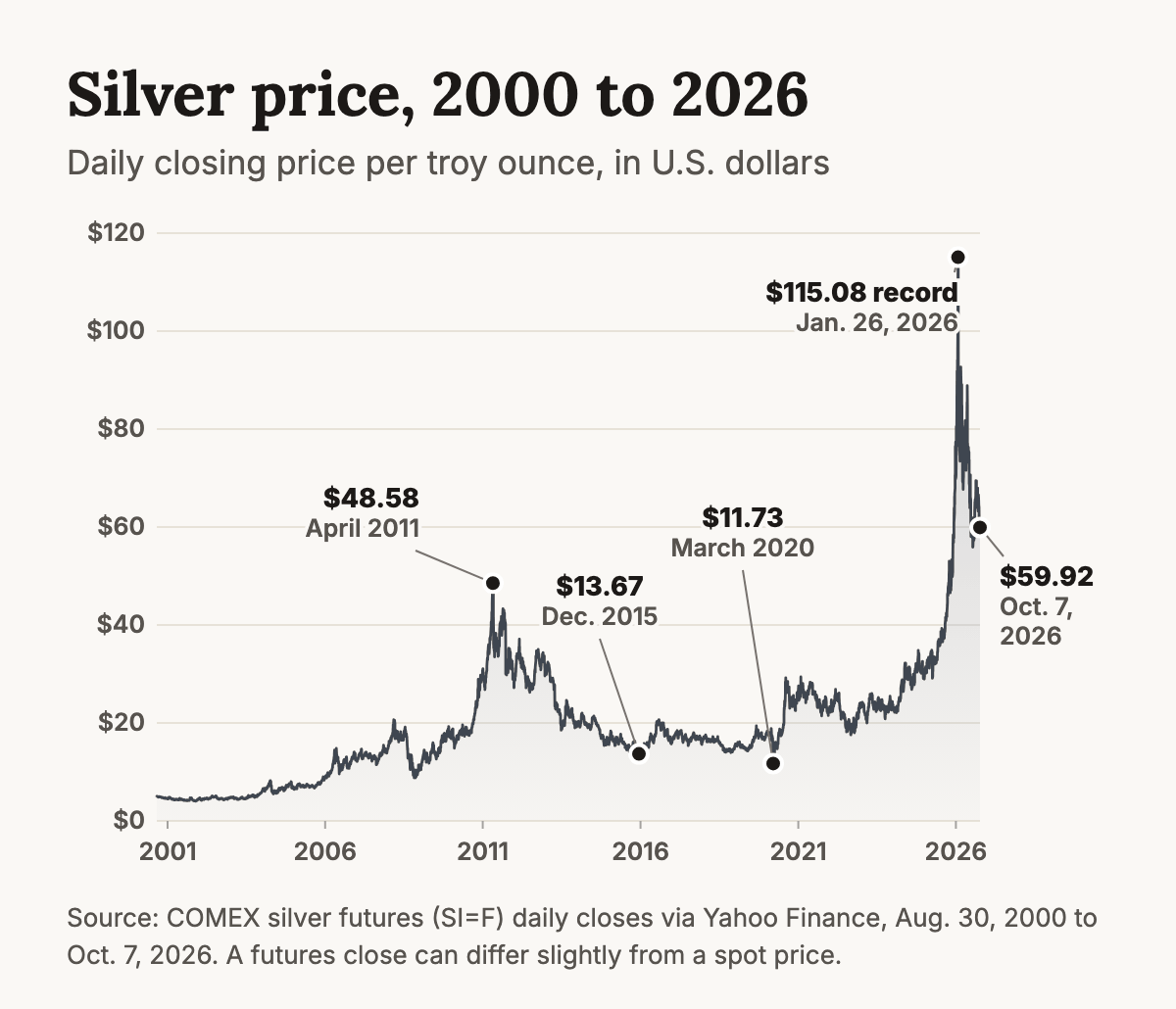
The chart shows every daily closing price since August 2000. Four stretches tell most of the story.
The long climb, 2001 to 2011. Silver spent the early 2000s near $5 an ounce. It rose through the decade, fell hard in the 2008 financial crisis, from $20.68 in March to $8.79 in October, a drop of 57% in seven months, and then rose more than fivefold to close at $48.58 on April 29, 2011.
The long slide, 2011 to 2020. After that peak, silver fell for most of a decade. It closed at $13.67 in December 2015, 72% below the 2011 high, then spent the next four years between roughly $14 and $21. In the market panic of March 2020 it touched $11.73, 76% below its 2011 close.
The recovery, 2020 to 2024. From the March 2020 low, silver more than doubled in five months, to $29.25 in August 2020. It then spent most of the next four years between about $18 and $30.
The surge and the fall, 2025 to 2026. Silver began 2025 at $29.62. It did not close above its April 2011 high until October 8, 2025, fourteen and a half years later. From there it ran to a record close of $115.08 on January 26, 2026. Four trading days later, on January 30, it closed at $78.29, the largest one-day fall in the whole 26-year series at 31%. By July 16, 2026 it had fallen to $55.90.

The last 21 months, up close
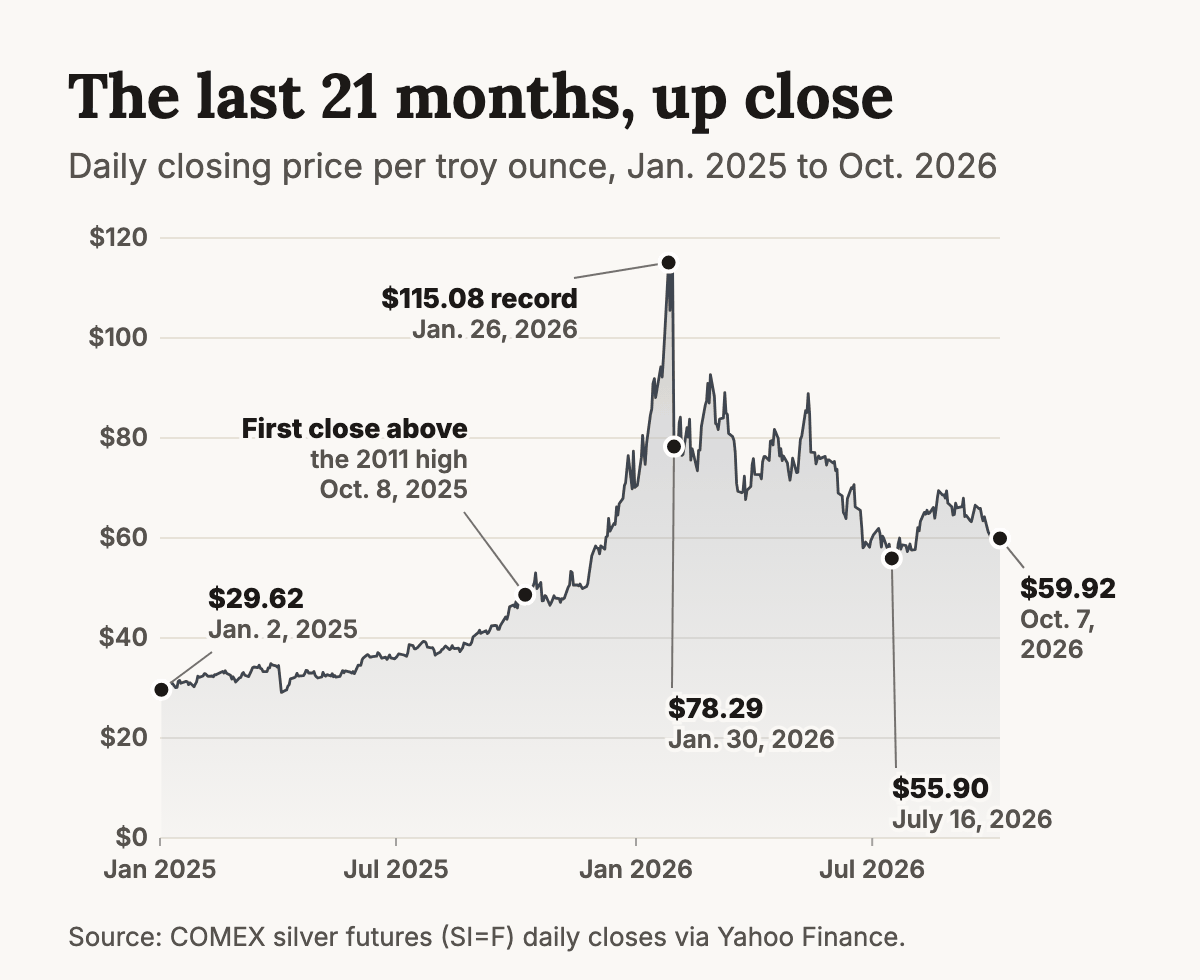
The recent past is what makes this question feel so urgent. In about a year, silver nearly quadrupled and then lost almost half its value. Moves that size are exactly what tempt people into two opposite mistakes: buying in a hurry because the price is rising, and refusing to buy at all because it has just fallen.
The zoomed chart is also a reminder of how fast silver can move. Between the record close and the close four days later, the price fell by more than $36 an ounce. A buyer who placed an order on January 26 and another who placed the same order on January 30 paid very different prices for identical metal. Gold fell too, but only about 22% from its own January record; our guide on whether to buy gold now or wait runs the same tests on gold.
The case for buying now
People who buy silver at a price like today's tend to give some version of these reasons. Each one has something to it.
- The price is well below its recent high. At $59.92, silver is 48% below the January 2026 record. For someone who wanted to buy at $100, today's price can look like the same metal at a large discount.
- It is still higher than it was for most of the last 26 years. For buyers who think of silver as a long-term holding, the recent fall does not undo a long-run rise. The price is about twelve times what it was in 2000.
- Waiting has its own risk. If the price rises while you wait, you pay more for fewer ounces. Silver last closed below $30 on April 8, 2025. Anyone who has been waiting since then for it to "come back down" to that level is still waiting.
- Silver has uses beyond being held. A large share of the silver produced each year goes into industry, from electronics to solar panels. That gives it a source of demand that does not depend only on buyers holding it as a store of value.
- Some people simply want to own it. If the reason you want silver is to hold something physical outside the financial system, the exact price on the day matters less than having it.
The case for waiting
The reasons to hold off are just as real.
- Silver can keep falling. The 2011 peak was followed by a slide that lasted most of a decade and took the price down 76%. A fall of 48% from a record is not, by itself, a sign that the fall is over.
- The price is still volatile. In the past twelve months silver has moved by tens of dollars in a matter of days. If a sharp move would make you sell in a panic, a smaller purchase, or none, may suit you better.
- You may not have the cash to spare. Silver pays no interest or dividends. Money you might need in the next year or two, or money that would pay down high-interest debt, is usually better left where it is.
- You may not have a place to keep it. Silver is bulky. If you have not decided where it will be stored, or have not checked what your insurance covers, buying first and sorting that out later is backward.
- You may not have compared sellers. The difference between a good and a poor price per ounce, or a good and poor buyback offer, can be larger than a month's price movement. Waiting a week to get two written quotes is not market timing; it is shopping.
Notice that the strongest reasons to wait are mostly about you, not about the market. That is a useful clue.
What 26 years of prices say about timing
We ran three simple tests on the same daily series shown in the charts, from August 2000 to October 2026. They describe the past. They do not predict anything, but they do show what the "wait for a better price" approach would have run into.
Test 1: buying all at once or spreading it out
For every month from January 2001 onward, we compared two buyers with the same money. One bought everything on the first trading day of the month. The other split it into twelve equal monthly purchases, starting the same day.
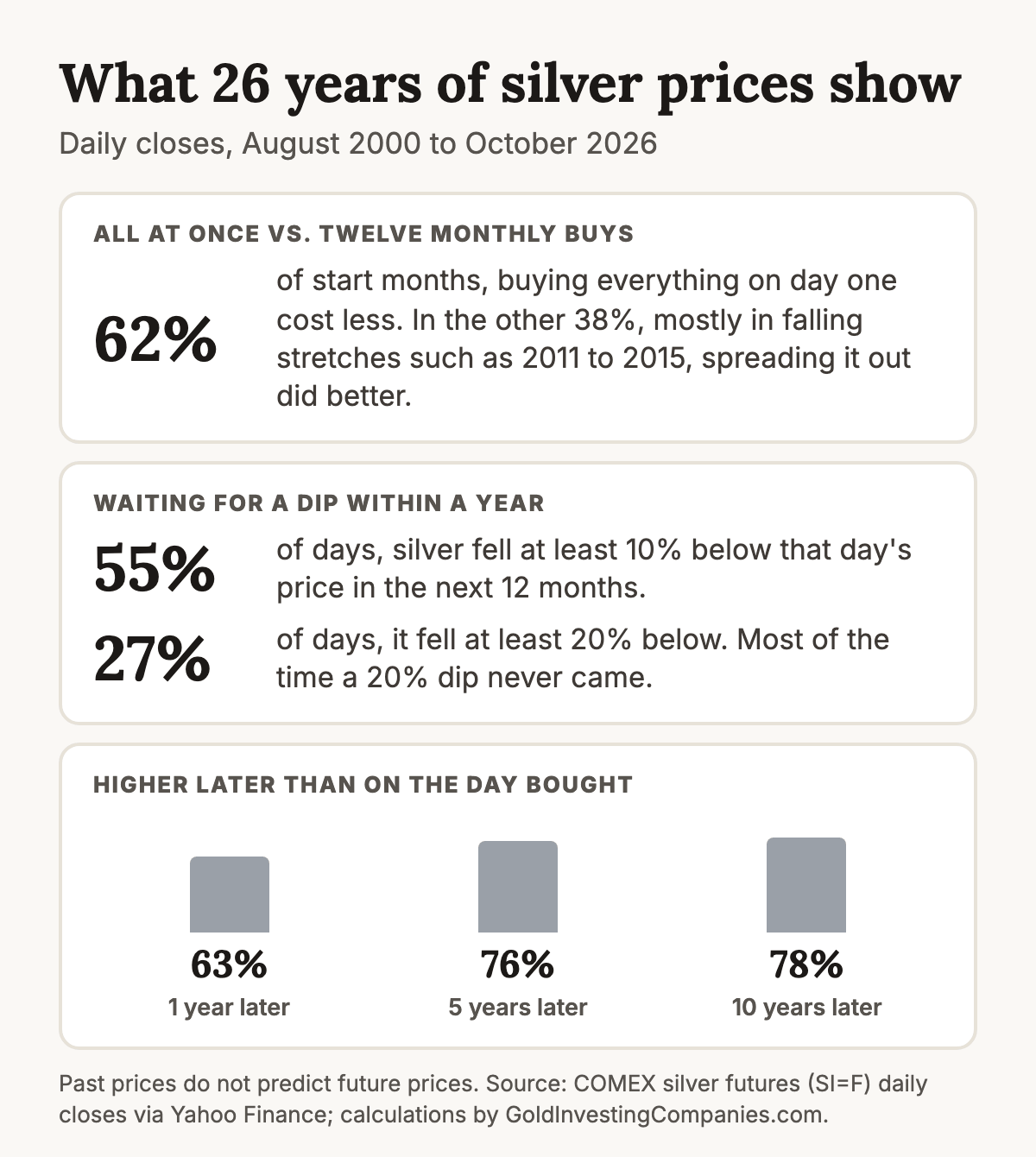
The single purchase got a lower average price in 184 of 299 start months, or 62% of the time. That is because silver's price rose over the period as a whole, so buying earlier usually beat buying later.
But the other 38% matters. It falls mostly in falling stretches, including start months near the 2008 and 2011 peaks, when buying everything at once meant paying close to the top and watching the price fall for years. Spreading purchases out did not win most often, but it protected buyers from the worst outcomes.
Test 2: how often did waiting for a dip pay off?
For every trading day from 2001 to October 2025, we asked whether silver fell below that day's price at some point in the following twelve months.
- It fell at least 10% below that day's price within a year on 55% of days.
- It fell at least 20% below within a year on 27% of days.
So waiting for a 10% dip has been close to a coin toss, and waiting for a 20% dip failed nearly three times out of four. And on the days when the dip never came, the waiting buyer either paid more later or did not buy at all.
Test 3: how often was silver higher later?
For every day in the series, we compared the price with the price one, five and ten years later.
| Held for | Higher at the end |
|---|---|
| One year | 63% of start days |
| Five years | 76% of start days |
| Ten years | 78% of start days |
Even across ten years, silver was lower at the end more than one time in five. Anyone who bought near the April 2011 high waited fourteen and a half years just to see that price again. A longer time horizon has helped, historically, but it has never been a guarantee.
What the three tests add up to
The data does not support confident timing in either direction. Waiting for a big dip usually failed, yet buying everything at once sometimes meant buying near a peak that took more than a decade to recover. The approach that held up most consistently was the least exciting one: decide how much silver suits you, then buy it in pieces.
A plan that does not need a forecast
If you have decided that owning some silver suits you, but you cannot decide on the moment, you do not have to. Many buyers use one of these three approaches.
1. Spread your purchases over time. Pick a total amount, divide it into equal parts, and buy one part each month or each quarter until you are done. This is often called dollar-cost averaging. When the price is high, your fixed amount buys fewer ounces; when it is low, it buys more. You will never buy at the exact bottom, and you will never put everything in at the exact top.
One practical catch with silver: small orders often carry a higher premium per ounce than large ones, and shipping and insurance are charged per order. Six or twelve purchases may each cost a little more per ounce than one large order. Ask the dealer what each order size costs before you settle on a schedule.
2. Buy part now and keep part in reserve. Some buyers put a portion in immediately, so they own something, and hold the rest to buy later or if the price falls. It is less tidy than a fixed schedule, and it leaves room for second-guessing, but it removes the fear of missing out entirely.
3. Buy it all at once, but size it sensibly. If spreading purchases out does not suit you, the other way to reduce timing risk is to buy only an amount you would be comfortable holding through a fall like 2011 to 2015, or January to July 2026. A purchase small enough that a 50% drop would not change your life is a purchase you are less likely to sell at the wrong moment.
Whichever you choose, write down the plan before you start. A plan written on a calm day is much easier to follow on a day when silver has just moved 10%.
Questions to answer before you decide
Market timing is a hard question. These are easier ones, and they usually decide the matter.
- Why do I want silver? To hold something physical, to keep a small amount on hand, as part of a retirement account, or because the price has been in the news? The last is the weakest reason.
- How much is right for me? Silver can fall by half. Decide on an amount you could hold through that.
- When might I need the money? If it could be within a couple of years, silver's swings make it a poor place for it.
- Where will it be kept? At home, in a bank box, at a private depository, or inside an IRA at an approved depository.
- In what form? Coins are easiest to sell in small amounts; bars cost less per ounce. Our guide to buying 1,000 ounces of silver compares the forms in detail.
- Have I compared two sellers? For the same items, in writing, with the price per ounce and the buyback price.
If you cannot answer the first three yet, waiting is the right choice, not because of the market but because you are not ready.

What matters more than the day you buy
Buyers spend a lot of energy on the spot price and very little on the things that often cost them more.
The premium. You never pay the spot price for physical silver. You pay spot plus a premium for minting, distribution and the dealer's margin, and it varies widely by product and seller. Bullion bars usually carry the smallest premium. Government-minted coins cost more. Collectible and "limited edition" coins can cost far more than the silver in them, and are not what anyone should be buying for the metal.
The buyback price. What a dealer will pay to buy your silver back is the other half of the deal. The gap between what you pay and what you could sell for today is your real cost of owning silver. Ask for both numbers in writing for the same items.
Storage and insurance. Silver takes up far more space than gold for the same money. Check what your home insurance covers before keeping it at home, and ask how storage is charged at a depository.
Tax when you sell. The IRS treats coins and bullion as collectibles, and says net capital gains from selling collectibles are taxed at a maximum rate of 28%. Keep every invoice. This is general information, not tax advice.
Avoiding the wrong seller. A seller offering silver well below the market price, pressing you to decide on the phone today, or steering you toward rare coins is a bigger risk than any price move. Our guide to gold bar scams covers the warning signs, and they apply to silver too.
Buying silver outright or inside an IRA
There are two ways to own physical silver, and the timing question looks slightly different in each.
Outright. You pay with your own savings, and the silver is shipped to you or to a depository of your choice. You can buy any form, keep it where you like, sell whenever you want, and spread purchases out with no paperwork.
Inside an IRA. The silver is owned by a self-directed retirement account, usually funded by moving money from an existing IRA or 401(k). It must be at least 99.9% pure, come from a national mint or an accredited refiner, and be held at an approved depository, not at home. Because the money is often moved in one transfer, the purchase usually happens in one go, though you can keep part of the balance in cash inside the account and buy metal later. Our guides to the silver IRA rollover and to gold and silver IRA accounts explain the rules.
If you are weighing the retirement route, our ranking of the best silver IRA companies compares three companies, and gold IRA vs silver IRA covers how the two metals differ.
Where to buy when you are ready
Whatever you decide about timing, buy from an established dealer with a long public record. The three companies we compare on this site all sell silver, for delivery or for a retirement account, and each offers a free guide that costs nothing to request and commits you to nothing.
- Augusta Precious Metals sells silver coins and bars for cash and for IRAs, and leads with education before any sale. Its minimum purchase is $50,000. It is the company we rank first overall.
- Goldco sells silver through a direct purchase or a silver IRA, and gives silver equal billing with gold. It currently advertises a free silver promotion on qualifying orders.*
- American Hartford Gold sells silver coins, bars and rounds, ships insured to your door for a delivery order, and publishes a $10,000 minimum for an IRA.
Reading a company's guide before you buy is a good use of the waiting period, if you choose one. Our article on the free gold IRA kit explains what these guides contain.
Claim Augusta's Free Gold & Silver Kit
Claim Goldco's Free Gold & Silver Kit
Claim American Hartford Gold's Free Guide
Mistakes to avoid
- Buying because the price is in the news. Headlines tend to follow big moves, not come before them.
- Waiting for a specific price. If silver never gets there, you may wait for years. Silver has not closed below $30 since April 2025.
- Putting in money you may need soon. Silver can fall by half and stay down for a long time.
- Judging a deal on the spot price alone. Compare the delivered price per ounce and the buyback price.
- Buying collectible coins for their silver. You pay for rarity, not metal.
- Buying all of it in a rush after a big rise, or none of it after a big fall. Both are reactions to the last few weeks, not decisions about the next few years.
- Not writing down a plan. Decide the amount, the schedule and the seller before the price moves again.
FAQ
Is now a good time to buy silver?
No one can say for certain. On October 7, 2026, silver was $59.92 an ounce, 48% below its January 2026 record close but about twelve times its price in 2000. Whether it suits you depends on why you want it, how much you would buy and when you might need the money, more than on today's price.
Will silver go down more?
It might. Silver fell 76% from its 2011 high to its 2020 low, and in our 26-year series it dropped at least 20% within a year from 27% of starting days. Nobody can predict the next move reliably, so it makes sense to plan for one in either direction.
Is it better to buy silver all at once or over time?
In our test, a single purchase cost less than twelve monthly purchases in 62% of start months since 2001, because silver rose over the period. Spreading purchases out won less often but avoided the worst results near peaks. Many buyers choose to spread purchases out for that reason.
What was the highest price of silver?
In the COMEX futures series used on this page, the record daily close was $115.08 an ounce, on January 26, 2026. Prices traded higher during that day. Spot prices from other sources can differ slightly.
How long did it take silver to recover after 2011?
Silver closed at $48.58 on April 29, 2011. It did not close above that price again until October 8, 2025, about fourteen and a half years later.
Should I wait for silver to drop before buying?
Waiting for a dip has a poor record. In our test, a 10% dip arrived within a year from about half of all starting days, and a 20% dip from about one in four. If you do wait, set a limit on how long, or spread purchases out instead.
Does buying silver in an IRA change the timing question?
Somewhat. An IRA purchase is often made in one go after a rollover, though you can keep part of the balance in cash inside the account and buy later. The IRS rules on purity and storage apply whenever you buy.
Is buying silver right for me?
That depends on your circumstances, and a website cannot judge them. Silver pays no interest, and its price moves sharply in both directions. Speak with a licensed financial professional who is not paid on the sale.
The bottom line
The honest answer to "should I buy silver now or wait?" is that the market will not tell you. Twenty-six years of prices show silver climbing more than tenfold, falling by three quarters, and doubling or halving within months. People who tried to time it well usually waited too long or bought at the wrong moment.
What you can control is the plan. Decide whether silver suits you, choose an amount you could hold through a large fall, pick a form and a place to keep it, compare two written quotes, and if the timing still worries you, buy in pieces. That approach does not need a forecast, and it has held up through every stretch on the chart.
Sources
- Silver prices: COMEX silver futures (SI=F) daily closes from Yahoo Finance, August 30, 2000 to October 7, 2026. The three timing tests were calculated by us from that series. Futures closes can differ slightly from spot prices.
- IRS Topic 409: capital gains and losses
- IRS: frequently asked questions about IRAs
- Each company's own website, as read for our company reviews in October 2026.
Claim Augusta's Free Gold & Silver Kit
*Applies only to qualified orders. Get up to 5% back in FREE Silver when you purchase $50,000 - $99,999. Get up to 10% in FREE Silver when you purchase $100,000 or more. Cannot be combined with any other offer. Additional rules may apply. Contact your representative to find out if your order qualifies. For additional details, please see your customer agreement. Goldco does not offer financial or tax advice.
More guides
 Silver
Silver IRA Rollover: Rules, Steps and What to Buy
How a silver IRA rollover works: moving a 401(k) or IRA into silver without tax, the IRS rules, which silver qualifies, and how storage differs from gold. Silver
Buy 1000 Ounces of Silver: Cost, Forms and Where to Buy
How to buy 1,000 ounces of silver: what it costs, the bars and coins it comes in, how much it weighs, storage, taxes, and where to buy it safely. Silver
Best Silver IRA Companies
Our 2026 ranking of the best silver IRA companies: Augusta Precious Metals, Goldco and American Hartford Gold, compared on record, minimums and storage.Looking for a company to buy from? See how Augusta Precious Metals, Goldco and American Hartford Gold compare.
Compare the three companies