Gold
Gold Bar Scams: How They Work and How to Avoid Them
Gold bars are a favourite tool of scammers for a simple reason. A bar is small, valuable, untraceable once it changes hands, and impossible to recall the way a bank transfer sometimes can be. Hand one to the wrong person and it is gone.
There are two broad kinds of gold bar scam. In the first, a criminal talks you into buying real gold bars and then takes them from you. In the second, you set out to buy gold and end up with a bar that is fake, overpriced, or does not exist at all. This guide covers both, using what U.S. regulators and law enforcement have published, and ends with a checklist for buying a bar safely.
The short version: no government agency, bank or tech company will ever ask you to buy gold bars or hand them to anyone. And if you are buying gold for yourself, buy from an established dealer, check the price against the market price, and take your time.

The gold bar courier scam
This is the scam behind most recent warnings, and it does not start with gold at all. It starts with fear.
The FBI's Internet Crime Complaint Center described it in a public service announcement in January 2024. Scammers pose as tech support staff, bank employees or U.S. government officials. They tell the victim that their accounts have been hacked or are about to be. Then they instruct the victim to protect their money by turning it into cash or into gold, silver or other precious metals. Once the victim has done so, the scammers send a courier to collect it, at the victim's home or in a public place, promising to keep it safe. The courier leaves, and the money is never seen again.
The Federal Trade Commission issued its own alert in July 2025 under a blunt headline: real government agents are not asking you to buy and deliver gold bars.
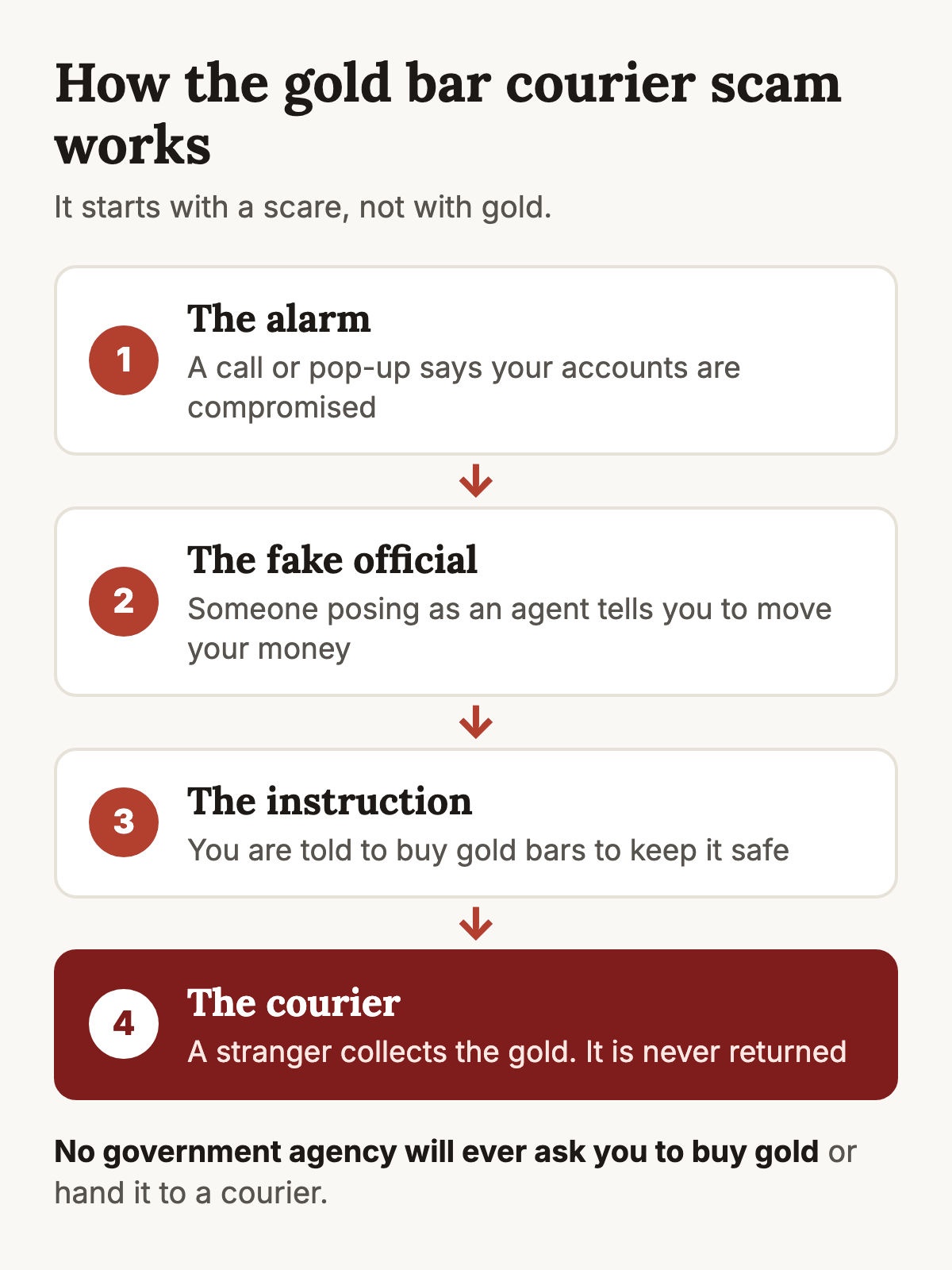
How it usually unfolds
- The alarm. A pop-up, text, email or phone call says your computer has a virus, your bank account has been breached, or your name is linked to a crime.
- The handover to "an official". You are passed to someone claiming to be from your bank's fraud team, a federal agency or law enforcement. Sometimes several people play different roles over days or weeks.
- The instruction. You are told your money is no longer safe where it is, and that the way to protect it is to withdraw it and buy gold bars. You are pressed to do it straight away.
- The collection. A courier arrives to take the gold for "safekeeping". The FBI says victims are sometimes given a passcode to exchange with the courier, to make the handover feel official.
How much is being lost
The numbers are large and rising.
- The FBI's complaint center reported losses of more than $55 million from this type of courier scheme between May and December 2023 alone.
- The FTC reported in August 2025 that reports from adults aged 60 and over who lost $10,000 or more to impersonation scams had increased more than four-fold since 2020. Among people who lost more than $100,000, combined losses rose from $55 million in 2020 to $445 million in 2024. The FTC noted that some victims were told to hand cash or gold to couriers.
Older adults are the main target, but anyone who can be frightened into acting quickly is at risk.
The warning signs
- You are contacted first, unexpectedly, about a problem you did not know you had.
- You are told to move, withdraw or "protect" your money.
- You are told to buy gold bars, or any precious metal.
- Someone offers to send a person to your home to collect cash or gold.
- You are pressed to act today.
Any one of these is enough to stop. The FBI's guidance is plain: the U.S. government and legitimate businesses will never ask you to purchase gold or other precious metals, and you should never agree to meet a stranger to hand over cash or metal.
Fake gold bars
The second family of scams targets people who actually want to buy gold. The most direct version is a bar that is not what it claims to be.
- Plated bars. A bar of cheap metal with a thin coating of gold. It looks right and may even carry convincing stamps.
- Filled bars. A real gold shell around a core of another metal. Tungsten is the usual choice because it weighs almost exactly the same as gold, so the bar passes a simple weight check.
- Forged packaging. Small bars are normally sold sealed in a card that shows the refiner, the weight, the purity and a serial number. Counterfeiters copy the card as well as the bar.
Fake bars turn up most often where there is no accountable seller: online marketplaces, social media listings, classified ads and private sales from someone met in person. The usual lure is price. Gold has a published market price that changes by the minute, and nobody sells real gold for much less than that price. A bar offered at a large discount is the warning, not the bargain.

Real bars at an unreal price
A bar can be perfectly real and still be a bad deal.
The Commodity Futures Trading Commission, which pursues fraud in precious metals, publishes a list of ten things to ask before buying physical gold. Several of them are about price. Its advice includes being wary of any dealer who contacts you first with an attractive offer, knowing the spot price before you talk to anyone, and comparing the spread, which is the gap between what a dealer sells for and what it would pay to buy back.
The pattern regulators describe is consistent. A salesperson calls, plays on worries about the economy, and steers the buyer toward "exclusive" or "limited" products that carry a far higher markup than ordinary bullion. The buyer receives genuine metal worth much less than they paid. Our gold scammer list sets out documented cases of exactly this, each linked to its regulator source.
Bars that never existed
In the third version, there is no bar at all.
- Storage schemes. You pay for gold that the seller says it will store for you. Regulators have brought cases in which customers were charged for storage and insurance on metal that was never bought.
- Financing schemes. You put down part of the price and the seller "lends" you the rest. In past cases the metal was never purchased, while the customer kept paying interest.
- Fake websites. A professional-looking online shop takes payment by wire or cryptocurrency and ships nothing.
The protection is the same in each case. If you are paying for gold you will not hold yourself, you should be able to confirm, independently and directly with the storage facility, that it exists and is held in your name.
How to buy a gold bar safely
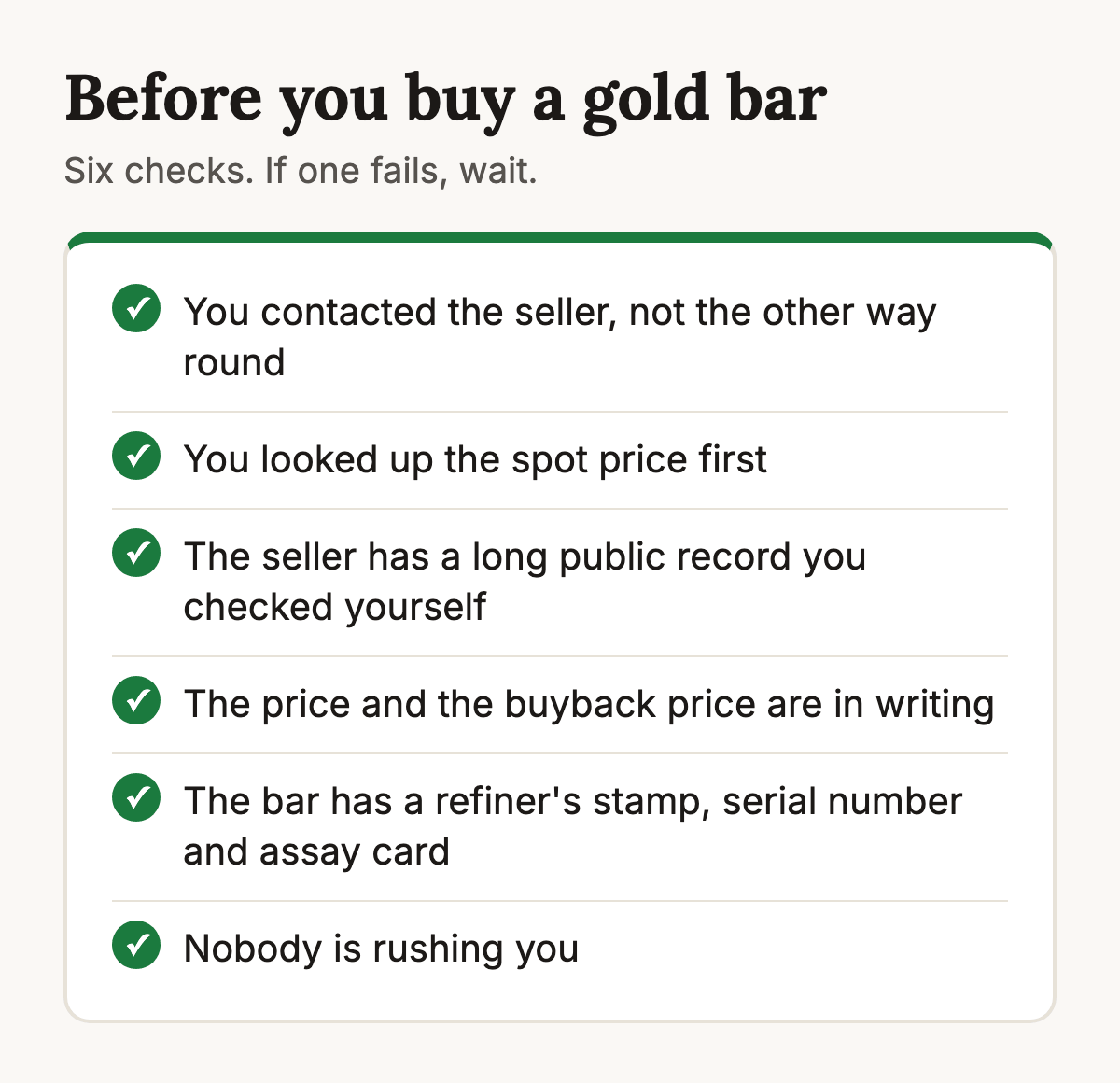
- You make the first contact. Do not buy from anyone who called, texted or emailed you first.
- Check the spot price before you talk to a seller. It takes a minute to look up, and it tells you at once whether a quote is reasonable.
- Look up the seller yourself. Check how long the business has existed, read its Better Business Bureau profile, and search its name alongside the words "complaint" and "lawsuit". Do not rely on badges shown on the seller's own website.
- Get the price in writing, both ways. Ask what you will pay for the exact bar, and what the seller would pay to buy the same bar back today.
- Buy standard bullion. A bar from a recognised refiner, with its weight, purity and serial number stamped on it, and its assay card if it is a small bar.
- Pay in a way that leaves a record. Be very cautious of any seller who insists on cryptocurrency, gift cards or cash handed to a courier.
- Take your time. A fair price today will still be fair next week. Pressure to decide now is the most reliable sign that something is wrong.
Buying from a long-established dealer with a public record costs a little more than a bargain from a stranger. That difference is the price of knowing the bar is real. If you want a starting point, our ranking compares three established gold companies on their public records, and our guide to banks that sell gold coins covers the few banks that still sell physical gold.
How to check a bar you already own
If you have bought a bar and have doubts, there are sensible steps before you panic.
- Compare it with the refiner's specifications. Genuine bars have published dimensions and weights. A bar that is the right weight but the wrong size is suspect.
- Check the serial number and the assay card. The number on the bar should match the card, and the printing should be sharp.
- Have it tested. A reputable coin shop or dealer can test a bar without damaging it, using equipment that reads the metal's composition and can detect a core of a different metal.
Home tests with magnets or kitchen scales catch only the crudest fakes. A tungsten-filled bar will pass both.
If you have been targeted
If someone has told you to buy gold bars to protect your money:
- Stop. Hang up, close the pop-up, and do not reply. Do not call a number they gave you.
- Do not hand over anything, and do not let anyone come to your home to collect it.
- Call your bank using the number on your card or statement, and tell them what happened.
- Tell someone you trust. A second opinion is the quickest way to break the spell.
- Report it. File a report with the FBI's Internet Crime Complaint Center at ic3.gov and with the FTC at ReportFraud.ftc.gov. If a courier is on the way or has just left, call your local police. The FBI says people aged 60 and over can also call the National Elder Fraud Hotline on 1-833-FRAUD-11.
If you have already handed over gold or cash, report it anyway and as soon as you can. Speed matters, and so does the record: these cases are investigated across many victims at once.
FAQ
What is the gold bar scam?
It is a scheme in which criminals posing as government agents, bank staff or tech support convince a victim that their money is at risk, tell them to convert it into gold bars, and send a courier to collect the bars for "safekeeping".
Will the government ever ask me to buy gold bars?
No. The FBI and the FTC both say that no government agency will ask you to buy gold or other precious metals, move your money to protect it, or hand cash or gold to a courier.
How can I tell if a gold bar is fake?
Compare its weight and dimensions with the refiner's published specifications, check that the serial number matches its assay card, and have it tested by a reputable dealer. A price far below the market price is the strongest warning sign before you buy.
Can a fake gold bar weigh the same as a real one?
Yes. Bars filled with tungsten weigh almost the same as solid gold, which is why a weight check alone is not enough.
Is it safe to buy gold bars online?
It can be, from an established dealer with a long public record. It is risky from marketplace listings, social media sellers and anyone who contacts you first.
Where do I report a gold bar scam?
To the FBI's Internet Crime Complaint Center at ic3.gov and to the FTC at ReportFraud.ftc.gov. Call your local police if a handover is about to happen or has just happened.
The bottom line
Gold bar scams come in two forms, and one rule covers both. If someone else is telling you to buy gold bars, it is a scam. If you have decided to buy gold yourself, choose the seller, check the price, and never let anyone hurry you.
Sources
- FBI Internet Crime Complaint Center: Scammers Use Couriers to Retrieve Cash and Precious Metals (January 29, 2024)
- FTC consumer alert: Real government agents aren't asking you to buy and deliver gold bars (July 17, 2025)
- FTC: reports of impersonation scammers stealing from older adults (August 7, 2025)
- CFTC: 10 Things to Ask Before Buying Physical Gold, Silver, or Other Metals
More guides
 Gold
GoldShould I Buy Gold Now or Wait? What 26 Years Show
Should you buy gold now or wait? A 26-year gold price chart, three timing tests from daily prices, the case each way, and a buying plan that needs no forecast. Gold
GoldUpdated Gold Scammer List for 2026
The gold dealers named in real regulatory actions and court judgments, the tactics they used, and how to check any gold company before you buy. Gold
GoldList of Banks That Sell Gold Coins
Most big U.S. banks don't sell gold coins. See which banks still do, what they actually offer, the trade-offs, and where most buyers go instead.Looking for a company to buy from? See how Augusta Precious Metals, Goldco and American Hartford Gold compare.
Compare the three companies