Gold IRA
Gold IRA vs Physical Gold: Taxes, Storage and Access
"Gold IRA vs physical gold" is a slightly misleading comparison, because a gold IRA holds physical gold too. The coins and bars in a gold IRA are real metal, sitting in a vault with your account's name against them. The real difference is who owns the metal and under which rules: a retirement account, or you personally.
That one difference changes almost everything else: how the gold is taxed, where it has to be kept, what you are allowed to buy, how quickly you can sell, and what money you can use to pay for it. This guide puts the two side by side so you can see which suits your situation, or whether you want some of each.
The short answer: a gold IRA suits people moving retirement savings into gold for the long term. It can be funded from a 401(k) or IRA without tax, the gold grows tax-deferred or tax-free, but it must stay in an approved depository and you cannot touch it until you take a distribution. Gold you own outright suits people who want the metal in their own hands and the freedom to sell any time. It is bought with money you have already paid tax on, and gains are taxed when you sell, at up to 28% as a collectible. Many buyers end up with both.
This is general information, not tax or financial advice. Tax rules below come from the IRS pages listed at the end, read on November 2, 2026.
Claim Augusta's Free Gold IRA Kit
The two ways to own gold
A gold IRA is a self-directed individual retirement account that owns physical precious metals. A custodian holds the account and reports to the IRS, a dealer sells you the metal, and an approved depository stores it. Legally, the IRA owns the gold; you own the IRA. Our gold IRA pros and cons guide weighs the account as a whole.
Physical gold owned outright is gold you buy with your own money and hold in your own name. It can be delivered to your home, kept in a bank safe deposit box, or stored at a private vault. It belongs to you from the moment you pay, with no account, custodian or retirement rules involved.
Both involve the same kinds of coins and bars. A one-ounce American Gold Eagle is the same coin whichever way you own it. What differs is everything around it.
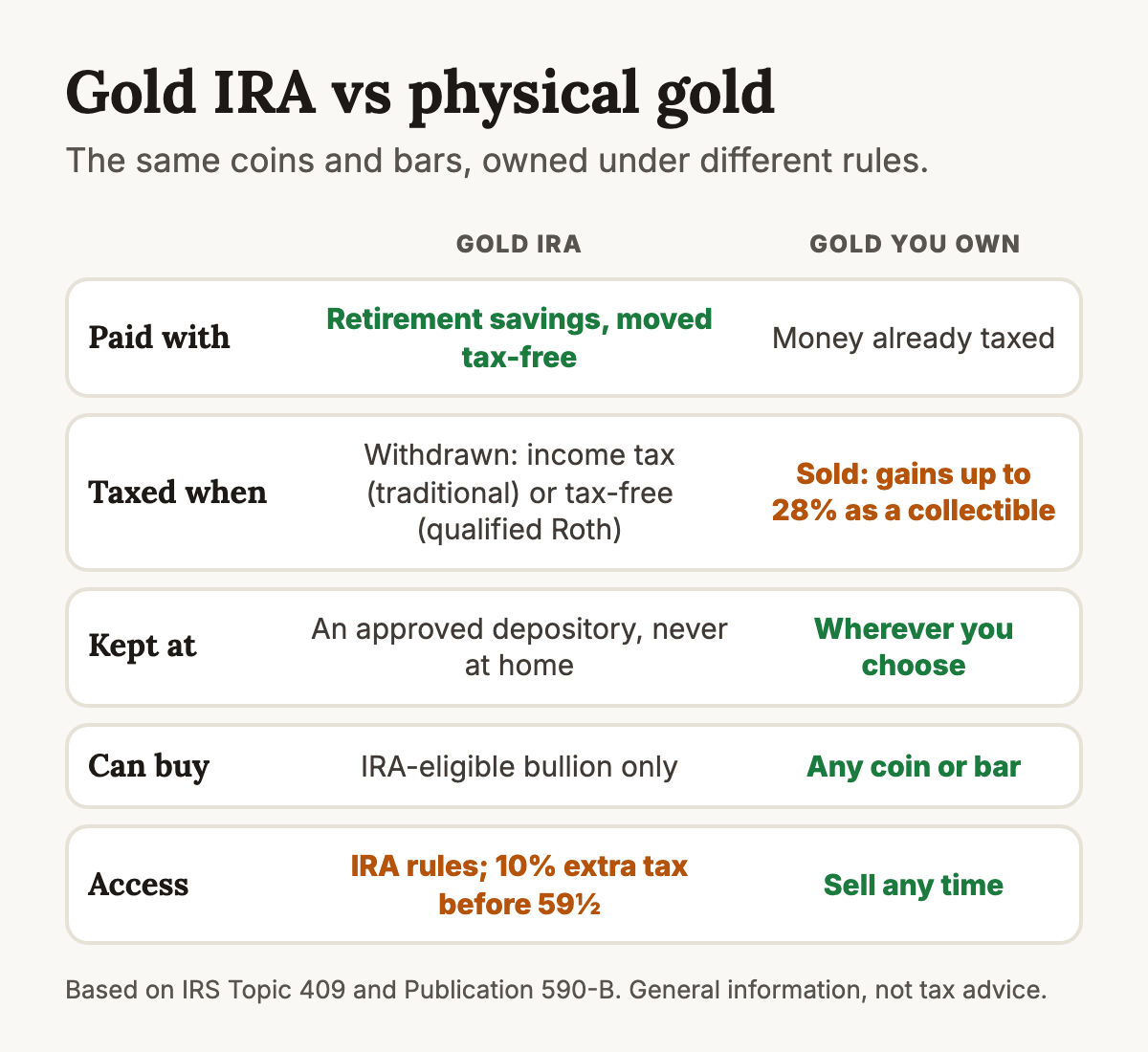
Gold IRA vs physical gold at a glance
| Gold IRA | Physical gold you own | |
|---|---|---|
| Paid for with | Retirement savings moved by rollover or transfer, or annual contributions | Money you have already paid tax on |
| Tax while you hold it | None | None |
| Tax when it leaves or is sold | Traditional: ordinary income. Roth: qualified withdrawals tax-free | Gains taxed when sold, at up to 28% as a collectible |
| Where it is kept | An approved depository, never at home | Wherever you choose |
| What you can buy | IRA-eligible bullion and certain coins only | Any coin or bar |
| Access | Through the custodian; distributions follow IRA rules | Any time |
| Before age 59½ | Withdrawals may face a 10% additional tax | No age rules |
| From age 73 | Required minimum distributions on a traditional IRA | None |
| Paperwork | A custodian, account forms, yearly IRS reporting by the custodian | An invoice |

How each is taxed
Tax is the biggest practical difference, and it cuts both ways.
Physical gold you own. The IRS treats coins and bullion as collectibles. It says net capital gains from selling collectibles are taxed at a maximum rate of 28%, and short-term gains, on metal held a year or less, are taxed as ordinary income. You pay nothing while you hold the gold, and nothing when you buy it beyond any sales tax your state charges. You report the gain or loss in the year you sell, so keep every invoice: your purchase price is what the gain is measured from.
A gold IRA. The IRA does not pay tax when it buys or sells, and there is no tax while the gold is held. Tax is settled when money or metal leaves the account:
- From a traditional gold IRA, withdrawals are added to your taxable income and taxed at ordinary income rates. That can be higher or lower than 28%, depending on your income in retirement.
- From a Roth gold IRA, qualified withdrawals are tax-free.
The trade-off. A traditional gold IRA lets money that has never been taxed buy gold, and defers the tax for years, but charges ordinary income tax at the end, including on the original amount, not just the gain. Gold owned outright is bought with taxed money, and only the gain is taxed, at a capped rate. A Roth gold IRA avoids tax at the end entirely, but it is funded with money that was taxed going in.
Which works out better depends on your tax rate now and in retirement, which is why this is a question for a tax professional. Our guide to gold IRA tax rules sets out the IRA side in full.
Funding: where the money comes from
This is often what decides the matter in practice.
A gold IRA can use retirement savings without tax. Most gold IRAs are funded by moving money from an existing 401(k), 403(b), Thrift Savings Plan or IRA. Done by direct rollover or transfer, the move is not taxed and does not count toward the annual contribution limit. New contributions are capped: for 2026, $7,500 across all your IRAs, or $8,600 if you are 50 or older.
Physical gold uses money you already have. To buy gold outright with retirement savings, you would first have to withdraw them, which is taxable and, before 59½, may carry a 10% additional tax. So for most people, gold bought outright comes from ordinary savings, and gold bought with retirement money goes into an IRA.
If your gold money is sitting in an old 401(k), our guide to the 401(k) to gold IRA rollover explains the move.
Storage and possession
Gold IRA. IRS Publication 590-B says IRA coins must be in the possession of the custodian or trustee of the IRA, and that if the owner takes possession of them, they are treated as distributed. So IRA gold sits at an approved depository. You will not see it or hold it unless you take it out as a distribution, which ends its IRA status. In exchange, it is stored by a specialist facility and insured there. You can usually choose between commingled storage, where your metal is pooled with other clients' identical metal, and segregated storage, where your own pieces are kept apart.
Be wary of any pitch for a "home storage gold IRA". Under the IRS rule above, IRA gold kept at home is treated as taken out of the account.
Physical gold owned outright. You decide. Each option has a trade-off:
- At home. Immediate access and no storage charge. You need a proper safe, and you should check whether your home insurance covers bullion, because many policies limit it.
- A bank safe deposit box. Secure, but the contents are not covered by FDIC insurance, and you can reach them only during bank hours.
- A private vault. Insured, purpose-built storage, often with segregated holdings, at a yearly cost.
Some people buy gold precisely because they want it within reach in a crisis. If that is your reason, only gold owned outright and kept close by meets it.

What you can buy
Gold IRA. Only metal that meets the IRS exception for IRAs. In practice, gold bullion must be at least 99.5% pure, and certain coins are allowed by name, such as the American Gold Eagle. Rare, collectible and "numismatic" coins are not allowed. If an IRA buys one, Publication 590-B says the amount is treated as distributed in that year.
Physical gold owned outright. Anything. You can buy bullion bars and coins, older coins like the South African Krugerrand, and collectible coins if you choose. That freedom has a downside: collectible coins usually carry large markups over the value of their gold, and they are where most high-pressure sales happen. For buying the metal itself, standard bullion is the sensible choice either way.
Access and selling
Physical gold owned outright can be sold whenever you like, to the dealer you bought from, a local coin shop or any other buyer. You decide the timing, and the money is yours the same day or soon after. That also makes it easier to sell on impulse, which is not always an advantage.
A gold IRA is built to be left alone. You can sell metal inside the account at any time, usually back to the dealer, and the cash stays in the IRA without tax. Getting money or metal out to you is a distribution, which follows IRA rules: taxable from a traditional account, and before 59½ possibly subject to the 10% additional tax. From age 73, a traditional gold IRA also has required minimum distributions, which can be taken in cash or in metal.
You can move gold out of an IRA and into your own hands. That is an in-kind distribution: the coins or bars are shipped to you, and from a traditional IRA their value that day is taxable income. After that, the metal is ordinary physical gold that you own.
Costs
We do not publish cost figures, because the numbers found online are often wrong. The structure is worth knowing, though.
- Both involve a premium over the spot price when you buy, and a gap between the buying and selling price when you sell. These vary by product and dealer more than by the type of ownership.
- A gold IRA adds the custodian's account charges and the depository's storage charges, every year.
- Physical gold owned outright adds whatever your storage choice costs: a safe and insurance at home, a safe deposit box, or a vault.
Ask any dealer for the price per ounce, the buyback price for the same items, and, for an IRA, every yearly charge from the custodian and depository, all in writing.
Paperwork and privacy
A gold IRA comes with an account application, a custodian agreement and, for a rollover, forms from your current plan. The custodian reports contributions, rollovers and the account's year-end value to the IRS each year.
Physical gold owned outright needs less paperwork, but it is not invisible. A business that receives more than $10,000 in cash in one transaction, or in related transactions, has to file IRS Form 8300. Most large purchases are paid by bank wire anyway. And gains are taxable when you sell, whether or not the buyer reports the sale to the IRS.
Which suits which buyer
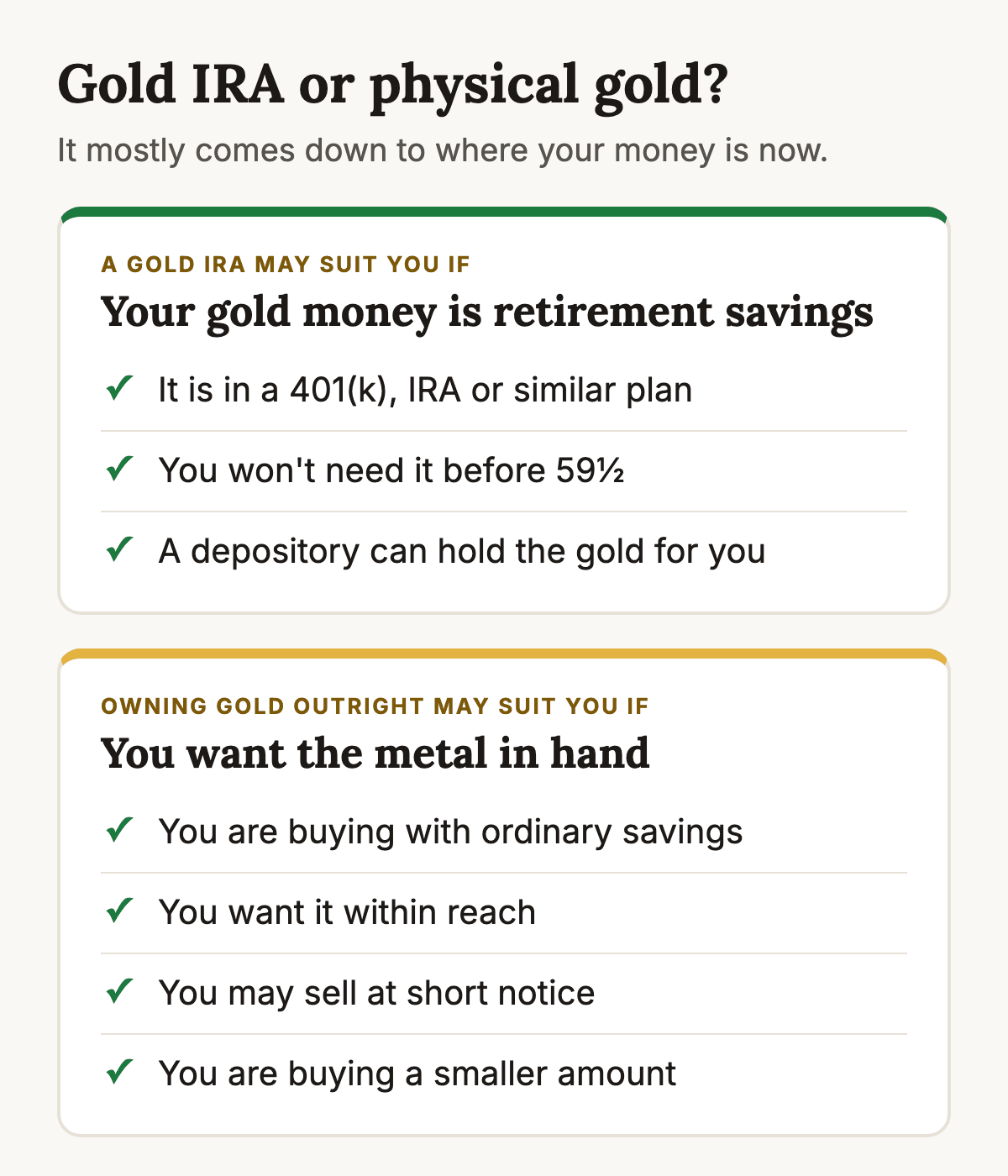
A gold IRA may suit you if:
- the money you want to put into gold is already in a 401(k), IRA or similar plan;
- you are buying for retirement and do not expect to need the money before 59½;
- you are comfortable with the gold being held for you at a depository;
- you would rather have a custodian handle storage and reporting.
Physical gold owned outright may suit you if:
- you are buying with ordinary savings;
- you want the metal in your own hands, or within reach in an emergency;
- you may want to sell at short notice;
- you are buying a smaller amount, where the yearly costs of an IRA would weigh more heavily.
Many people choose both: retirement savings moved into a gold IRA for the long term, and a smaller amount of coins kept at home. The two do not conflict, and each covers what the other cannot.
Whichever you choose, decide how much of your savings belongs in gold at all. Gold pays no interest or dividends and its price can fall for years. Our guide on whether to buy gold now or wait shows how far it has fallen in the past.
Where to buy either kind
All three companies we compare on this site sell gold for IRAs and for delivery outside a retirement account.
- Augusta Precious Metals sells gold and silver for IRAs and for purchases with personal funds, which it ships insured. Its minimum is $50,000 whether the purchase is made through an IRA or with personal funds. It leads with education and is our first-ranked company.
- Goldco sells gold and silver for IRAs and for direct purchase, and has the most specific written buyback policy of the three.
- American Hartford Gold sells gold, silver and platinum for IRAs and for delivery; for a delivery order its site says no account or custodian is required. It states a $10,000 minimum order for its gold IRA.
The full comparison is in our ranking. Each company offers a free guide, and our article on the free gold IRA kit explains what they contain. If you are buying gold to keep yourself, our guides to gold bar scams and the banks that sell gold coins are worth reading first.
Claim Augusta's Free Gold IRA Kit
Claim Goldco's Free Gold IRA Kit
Claim American Hartford Gold's Free Guide
Mistakes to avoid
- Withdrawing retirement savings to buy gold outright. Tax, and possibly the 10% additional tax, come off the top. A rollover into a gold IRA avoids both.
- Falling for a "home storage" gold IRA. IRA gold kept at home is treated as distributed.
- Buying collectible coins for the gold. Markups are high, and in an IRA they are not allowed at all.
- Forgetting the tax on gold you own. Gains are taxable when you sell, at up to 28%. Keep your invoices.
- Keeping home gold uninsured. Check your policy before the metal arrives.
- Putting money you may need soon into a gold IRA. Getting it out early can cost tax and the 10% additional tax.
FAQ
Is a gold IRA physical gold?
Yes. A gold IRA owns real coins and bars, stored at an approved depository. The difference from gold you own outright is that the IRA owns it, under retirement account rules, and you cannot keep it at home.
Which is taxed less, a gold IRA or physical gold?
It depends. Gains on gold you own are taxed at up to 28% when you sell. A traditional gold IRA is taxed at ordinary income rates on withdrawals, which may be higher or lower than that. A Roth gold IRA is tax-free on qualified withdrawals. A tax professional can compare them for your income.
Can I take physical gold out of my gold IRA?
Yes, as an in-kind distribution. The metal is shipped to you and becomes yours. From a traditional IRA, its value that day is taxable income, and before 59½ the 10% additional tax may apply.
Can I use my 401(k) to buy physical gold to keep at home?
Not without withdrawing the money first, which is taxable and, before 59½, may carry a 10% additional tax. Moving the 401(k) into a gold IRA by direct rollover avoids that, but the gold must then stay at a depository.
Is it safer to keep gold at home or in a depository?
A depository is purpose-built and insured; home storage depends on your safe, your insurance and your circumstances. IRA gold must be held at a depository in any case.
Should I have both?
Many people do: retirement savings in a gold IRA for the long term, and a smaller amount of coins at home for access. Whether that suits you depends on your circumstances.
Is buying gold right for me?
That depends on your circumstances, which a website cannot judge. Gold pays no income and its price can fall. Speak with a licensed financial professional who is not paid on the sale.
The bottom line
A gold IRA and gold you own outright hold the same metal under different rules. A gold IRA is the way to put retirement savings into gold without tax on the move, at the cost of keeping it in a depository and following IRA rules to get it out. Physical gold owned outright gives you the metal and the freedom to sell, but it is bought with taxed money and its gains are taxed as collectibles.
Start with where your money is and why you want gold. Retirement savings and a long horizon point to a gold IRA; ordinary savings and a wish to hold the metal point to buying outright. Many buyers do some of each.
Sources
- IRS Topic 409: capital gains and losses
- IRS Publication 590-B: distributions from IRAs
- IRS: IRA contribution limits
- IRS: Rollovers of retirement plan and IRA distributions
- IRS: Form 8300 and reporting cash payments of over $10,000
- Augusta Precious Metals and American Hartford Gold websites, read on November 2, 2026.
Claim Augusta's Free Gold IRA Kit
More guides
 Gold IRA
 Tax Rules: Contributions, Withdrawals and RMDs
Gold IRA tax rules for 2026: contribution limits, how withdrawals are taxed, Roth rules, RMDs on metal, in-kind distributions, and mistakes that trigger tax. Gold IRA
 Fees: What You Pay For and How to Compare
Gold IRA fees explained: every charge you may pay, which are one-time and which repeat, the hidden cost in the spread, and how to compare quotes in writing. Gold IRA
401(k) to Gold IRA Rollover: Rules, Steps and Pitfalls
How to roll a 401(k) into a gold IRA: when your plan lets money leave, the direct rollover, the 20% withholding trap, Roth and loan rules, and the steps.Looking for a company to buy from? See how Augusta Precious Metals, Goldco and American Hartford Gold compare.
Compare the three companies