Gold IRA
Gold IRA Tax Rules: Contributions, Withdrawals and RMDs
A gold IRA is taxed like any other IRA. The same contribution limits apply, the same rules decide when a withdrawal is taxable, and the same required minimum distributions begin at 73. What is different is the asset. Physical gold raises tax questions that a fund never does: what happens if you take coins out instead of cash, how you meet a required distribution when your account holds bars, and why keeping the metal at home is treated as cashing out.
This guide sets out the IRS rules as they apply to a gold IRA in 2026, with the figures the IRS has published for this year.
The short version: inside the IRA, gold grows without yearly tax. A traditional gold IRA is taxed as ordinary income when you take money or metal out; a Roth gold IRA is tax-free on qualified withdrawals. Gold held in an IRA is taxed under IRA rules, not the collectibles rate that applies to gold you own outright. The rules that catch people are the storage rule, the purity rule, early withdrawals before 59½, and required minimum distributions on an account that holds metal.
This is general information, not tax advice. The rules and figures below come from the IRS pages listed at the end, read on November 2, 2026. Ask a tax professional how they apply to your situation.
Claim Augusta's Free Gold IRA Kit
The basic idea: gold in an IRA follows IRA rules
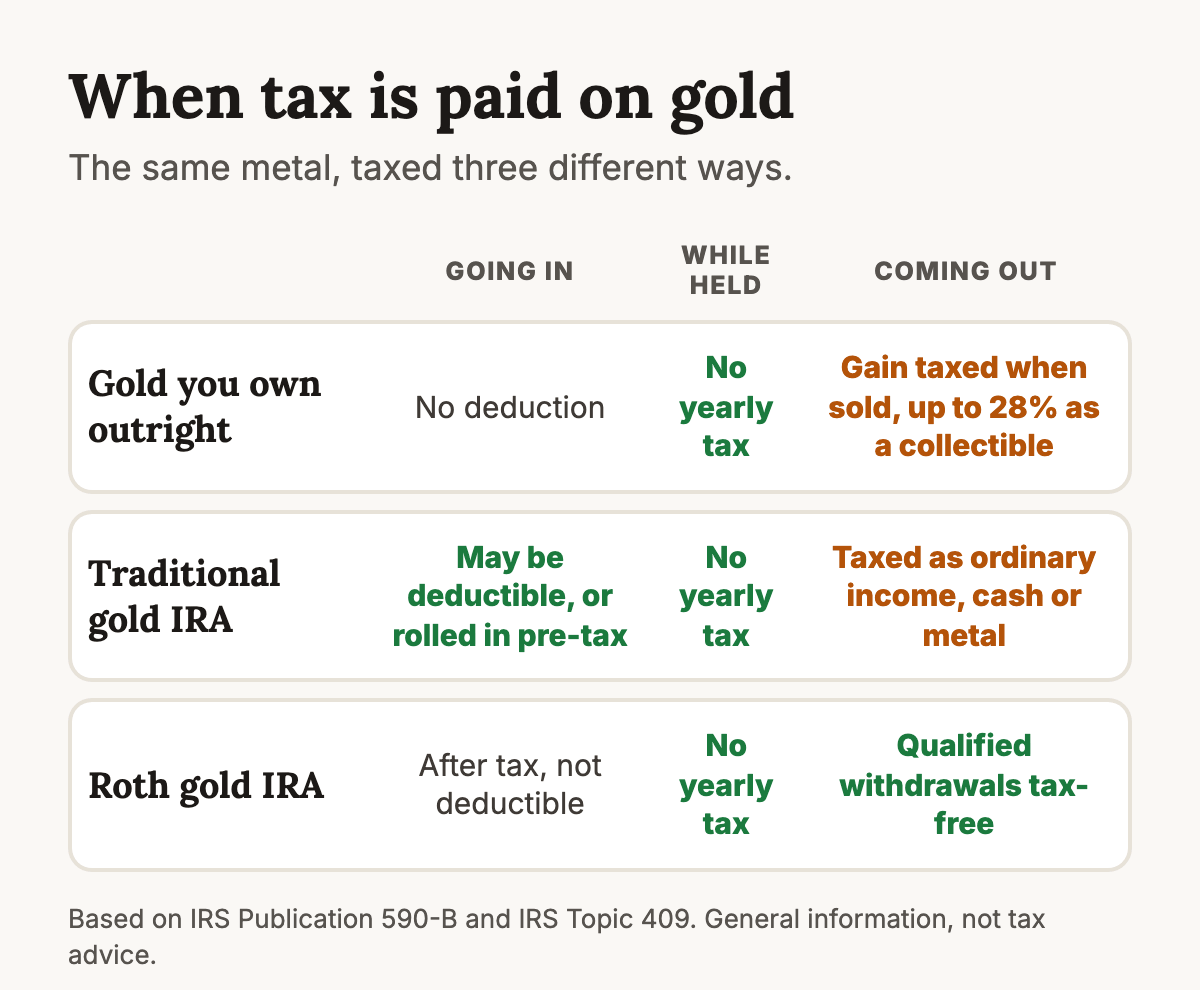
When you own gold coins or bars outright, the IRS treats them as collectibles. The IRS says net capital gains from selling collectibles are taxed at a maximum rate of 28%, higher than the top rate on most long-term gains.
Inside an IRA, that does not apply in the same way. The IRA does not pay tax when it buys or sells gold, and there is no yearly tax on any rise in its value. Tax is settled when money or metal leaves the account, and it is settled under the IRA's own rules:
- Traditional gold IRA: withdrawals are added to your taxable income for the year and taxed at your ordinary income tax rate.
- Roth gold IRA: qualified withdrawals are tax-free.
That trade-off is the core of gold IRA taxation. A traditional account defers the tax and then charges it at income tax rates. A Roth account charges nothing at the end, because the money went in after tax.
How much you can put in: 2026 contribution limits
For 2026, the IRS limit on combined contributions to all your traditional and Roth IRAs is:
| Age | 2026 limit | 2025 limit |
|---|---|---|
| Under 50 | $7,500 | $7,000 |
| 50 or older | $8,600 | $8,000 |
The limit is a total across all your IRAs, not per account. If you contribute $5,000 to an ordinary Roth IRA, you can put only $2,500 more into a gold IRA for 2026 if you are under 50. It is also capped at your taxable compensation for the year if that is lower.
Roth income limits. Your ability to contribute to a Roth IRA phases out as income rises. For 2026, the IRS says the phase-out range is $153,000 to $168,000 for single filers and heads of household, and $242,000 to $252,000 for married couples filing jointly.
Rollovers and transfers do not count. Money moved from a 401(k) or another IRA by a rollover or direct transfer does not count toward the annual limit. That is why most gold IRAs are funded with existing savings rather than new contributions. Our guides to the gold IRA rollover and the 401(k) to gold IRA rollover explain how that money moves without tax.
Too much in? The IRS says excess contributions are taxed at 6% for each year they stay in the IRA. To avoid that tax, withdraw the excess and anything it earned by your tax return's due date, including extensions.

Traditional or Roth: which tax treatment applies
Both kinds of IRA can hold gold. The choice decides when you pay tax.
Traditional gold IRA. Contributions may be deductible, depending on your income and whether you have a workplace plan. Savings rolled over from a traditional 401(k) or IRA arrive pre-tax. Everything you take out later, whether cash or metal, is generally taxable income in the year you take it.
Roth gold IRA. The IRS says you cannot deduct contributions to a Roth IRA. In return, qualified distributions are tax-free. Under IRS Publication 590-B, a distribution is qualified when it is made after the five-year period that begins with the first tax year you contributed to a Roth IRA, and it is made:
- on or after the date you reach 59½;
- because you are disabled;
- to a beneficiary or your estate after your death; or
- for a first home, up to a $10,000 lifetime limit.
Converting to a Roth. You can convert a traditional gold IRA to a Roth gold IRA. The amount converted, which for metal means its value at the time, is added to your taxable income that year. Some people convert in a year when their income is low, or when the price of gold is lower, so that less tax is due on the same number of ounces. That is a planning decision to make with a tax professional.
Withdrawals before 59½
The IRS says withdrawals from an IRA before age 59½ may face a 10% additional tax, on top of the ordinary income tax. The IRS lists exceptions, such as disability and certain medical costs, and its exceptions table should be checked before relying on one.
With a gold IRA, an early withdrawal usually means selling metal inside the account and taking cash, so both taxes apply to the cash you receive. Taking the metal itself counts the same way. An early withdrawal is rarely a good use of a gold IRA, and it is one reason to fund one only with money you will not need before retirement.
Taking gold out: cash or metal
When you take a distribution from a gold IRA, you have two choices.
Sell and take cash. The custodian sells the metal you choose, usually back to the dealer, and pays you the proceeds. From a traditional IRA, the cash is taxable income.
Take the metal itself. This is called an in-kind distribution. The coins or bars are shipped to you and become your property. From a traditional IRA, their fair market value on the day of the distribution is generally included in your income, even though you received no cash, so you need other money to pay the tax. From a Roth IRA, the IRS says the basis of distributed property is its fair market value on the date of distribution, whether or not the distribution is qualified.
That basis matters later. Once the metal is out of the IRA, you own it outright. If you sell it at a gain, the gain above that value is taxed under the ordinary rules for gold you own, including the collectibles rate.

Required minimum distributions on a gold IRA
The IRS says required minimum distributions from a traditional IRA must begin at age 73. You can delay the first one until April 1 of the following year, though that means taking two in one year. Roth IRAs have no required minimum distributions while the owner is alive.
A gold IRA raises three practical points.
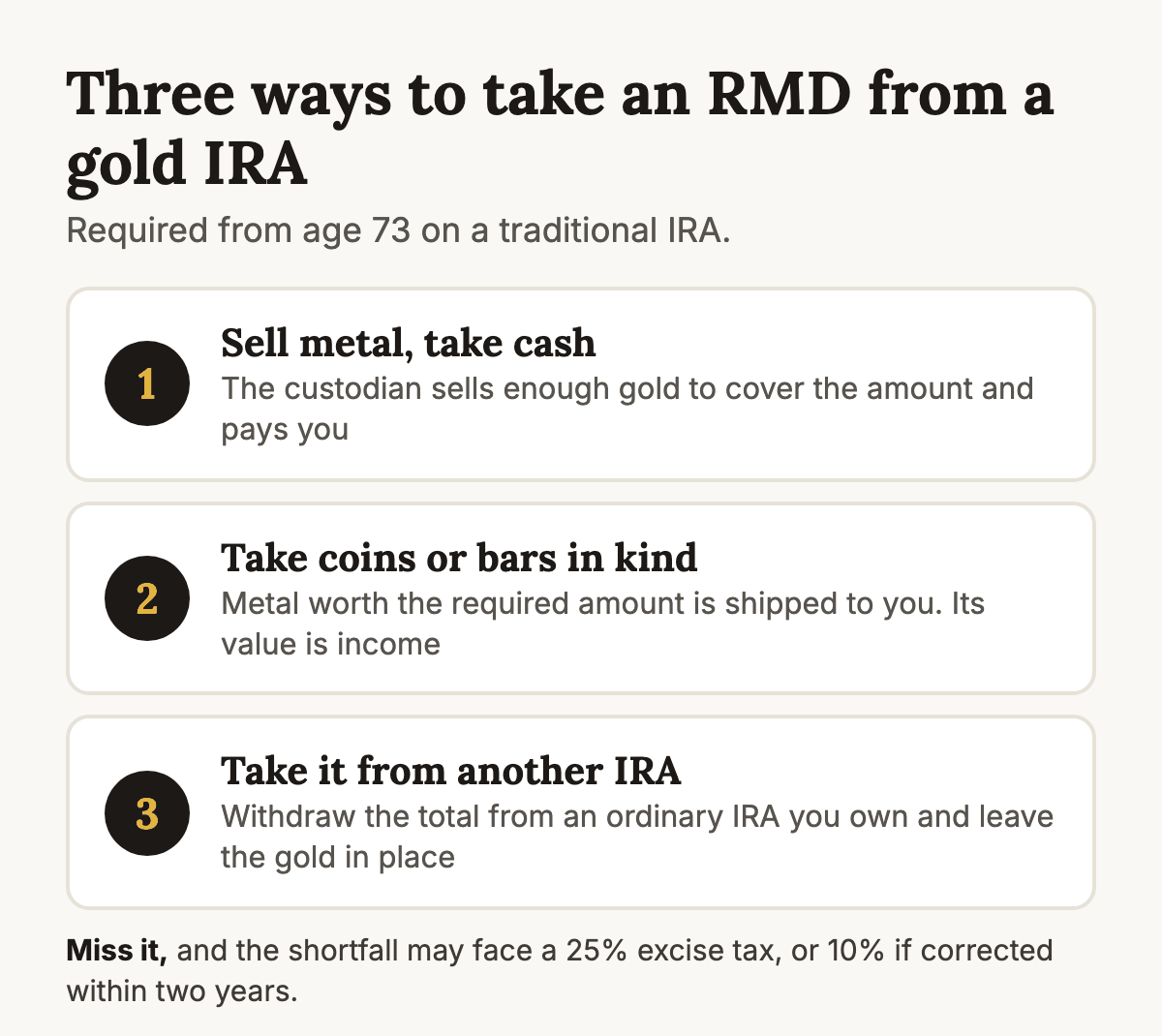
The amount is based on the account's value. Publication 590-B says each year's required amount is figured from the IRA's balance on December 31 of the previous year, and for a gold IRA that value depends on the price of the metal. The custodian reports it.
You can satisfy it with cash or metal. You can sell enough metal to cover the amount, or take coins or bars worth that amount in kind. Either way, the value is taxable income.
You can take it from another IRA. The IRS says each IRA's required amount is figured separately, but you can withdraw the total from one or more of your IRAs. So if you also have an ordinary IRA, you can take the gold IRA's share from it and leave the metal untouched. This only works across IRAs; a 401(k) has its own required distributions.
If you miss one, the IRS says the shortfall may face a 25% excise tax, or 10% if the distribution is corrected within two years.
Small units make required distributions easier. A gold IRA that holds only large bars can be awkward to divide; holding some one-ounce coins alongside them gives you room to take out exactly what you need.
The rules that turn your gold into taxable income
A few IRS rules can make the value of your gold taxable before you intend to take anything out. These are the ones to understand before you open an account.
Only eligible metal
The IRS does not allow IRAs to hold collectibles, and coins and metals generally count as collectibles. IRS Publication 590-B lists the exception: certain U.S. gold coins in one, one-half, one-quarter and one-tenth ounce sizes, certain platinum coins, and certain gold, silver, palladium and platinum bullion. In practice, gold bullion must be at least 99.5% pure, and the American Gold Eagle is allowed by a specific exception.
If your IRA buys something that does not qualify, Publication 590-B says the amount is considered distributed to you in the year it was bought, and the 10% additional tax may apply if you are under 59½. This is why rare, "numismatic" and "limited edition" coins have no place in a gold IRA, whatever a salesperson says.
The custodian must hold it
Publication 590-B says the coins must be in the possession of the custodian or trustee of the IRA, and that if the owner takes possession of them, they are treated as distributed. That rules out "home storage" gold IRAs. The U.S. Tax Court reached the same conclusion in a 2021 case, McNulty v. Commissioner, where IRA coins kept by the owner were treated as distributed.
An approved depository holds the metal on the custodian's behalf. It is the only safe place for IRA gold.
No personal use and no dealing with yourself
An IRA cannot be used to benefit you personally before you take money out. The IRS calls these prohibited transactions. Publication 590-A gives examples: borrowing money from the IRA, selling property to it, using it as security for a loan, and buying property for personal use with IRA funds. So gold you already own cannot be sold into your IRA. The IRS says that if you engage in a prohibited transaction, the account generally stops being an IRA as of the first day of that year, and its value is treated as distributed to you.
What you report, and what the custodian reports
A gold IRA creates a small amount of paperwork each year.
- Form 5498. The custodian reports your contributions and rollovers, and the account's year-end fair market value, to you and the IRS.
- Form 1099-R. Issued for any year you take a distribution, cash or metal, or do a rollover. A direct rollover is coded as non-taxable.
- Form 8606. Used if you have made non-deductible contributions to a traditional IRA, or take distributions from a Roth IRA that are not qualified.
- Form 5329. Used to report additional taxes, such as the 10% early distribution tax, the 6% tax on excess contributions or a missed required distribution.
Keep every confirmation from the custodian and the dealer. They record what you bought, when, and at what price.
Inherited gold IRAs
If you inherit a gold IRA, the rules depend on your relationship to the owner. A surviving spouse can generally treat the IRA as their own. Most other beneficiaries who are not "eligible designated beneficiaries" fall under the 10-year rule, which Publication 590-B says requires them to withdraw the entire balance by the end of the tenth year after the owner's death. Eligible designated beneficiaries include the surviving spouse, the owner's minor child, a disabled or chronically ill person, and anyone not more than 10 years younger than the owner.
An inherited gold IRA can be emptied in cash, in metal, or a mix. From a traditional IRA, each distribution is taxable income to the beneficiary. Spreading withdrawals across several years can keep the tax in each year lower than taking it all at once.
Mistakes that create a tax bill
- Taking a 401(k) or IRA payout as a check made out to you. Withholding and a 60-day deadline follow. Use a direct rollover or transfer.
- Contributing over the limit, especially across several IRAs. The 6% tax repeats every year until it is fixed.
- Buying collectible coins in the IRA. The purchase is treated as a distribution.
- Keeping IRA gold at home. Treated as a distribution of the whole amount.
- Selling your own gold to your IRA. A prohibited transaction.
- Forgetting a required distribution because the account holds metal rather than cash.
- Taking metal in kind without cash for the tax. The value is income even though no money changes hands.
How Augusta Precious Metals approaches gold IRA taxes
Tax rules are where a gold IRA company's attitude to education shows. Augusta Precious Metals builds its process around explaining the account before anything is sold. It offers a one-on-one web conference designed by its director of education, Devlyn Steele, which covers how the account works, what the custodian and depository do, and the questions to ask any dealer. Augusta says the session is for savers with $100,000 or more in savings.
Augusta also names the parties that handle the tax side of the account in advance. It works with Equity Trust Company as its preferred custodian (the custodian is the party that files IRS forms such as 5498 and 1099-R), and it stores metals at Delaware Depository, an approved depository, so the storage rule is met from the start. Its minimum purchase is $50,000, which suits savers moving an existing retirement account rather than making annual contributions.
Augusta's free Gold & Silver IRA Info Kit explains the account in writing. Requesting it does not open an account or move any money, and it is a sensible thing to read before you speak to anyone. Our Augusta Precious Metals review covers the company in detail, and our article on the free gold IRA kit describes what the guide contains.
Augusta says it does not offer tax advice, and neither do we. For your own situation, bring the kit and your questions to a tax professional.
Claim Augusta's Free Gold IRA Kit
FAQ
How is a gold IRA taxed?
Like any IRA. A traditional gold IRA is taxed as ordinary income when you take money or metal out. A Roth gold IRA is tax-free on qualified withdrawals. There is no yearly tax on the gold's growth inside the account.
Does the 28% collectibles rate apply to a gold IRA?
Not while the gold is in the IRA. Withdrawals follow IRA rules instead. The collectibles rate applies to gold you own outright, including metal you take out of an IRA and later sell at a gain.
How much can I contribute to a gold IRA in 2026?
Up to $7,500 across all your IRAs, or $8,600 if you are 50 or older, capped at your taxable compensation. Rollovers and transfers from other retirement accounts do not count toward the limit.
Do I pay tax if I take physical gold out of my IRA?
From a traditional IRA, yes. The fair market value of the metal on the day of the distribution is generally taxable income. From a Roth IRA, a qualified distribution is tax-free.
Do gold IRAs have required minimum distributions?
Traditional gold IRAs do, starting at age 73. You can meet them with cash, with metal, or by taking the amount from another IRA you own. Roth gold IRAs have none while the owner is alive.
Can I store my gold IRA at home?
No. IRS Publication 590-B says IRA coins must be held by the custodian or trustee, and that taking possession treats them as distributed.
Is a gold IRA rollover taxable?
Not when done by direct rollover or transfer between accounts of the same type. Moving traditional money into a Roth gold IRA is a taxable conversion.
Is a gold IRA right for me?
That depends on your circumstances, which a website cannot judge. Gold pays no income and its price can fall. Speak with a licensed financial professional who is not paid on the sale.
The bottom line
The tax rules for a gold IRA are the IRA rules you may already know, applied to an unusual asset. Gold grows inside the account without yearly tax, a traditional account is taxed as income when you take money or metal out, and a Roth account is tax-free on qualified withdrawals. The rules worth extra attention are the ones physical metal brings: buy only eligible bullion, leave it with the custodian, plan required distributions around the metal you hold, and remember that metal taken out in kind is income even without cash.
Read the rules, ask a tax professional the questions specific to you, and choose a company that explains the account before it sells you anything.
Sources
- IRS: IRA contribution limits
- IRS: 2026 limits announcement, including Roth IRA income ranges
- IRS: required minimum distributions FAQs
- IRS: IRA distributions and withdrawals FAQs
- IRS Publication 590-A: contributions to IRAs, including prohibited transactions
- IRS Publication 590-B: distributions from IRAs
- IRS: Roth IRAs
- IRS Topic 409: capital gains and losses
- Augusta Precious Metals website, read on November 2, 2026.
Claim Augusta's Free Gold IRA Kit
More guides
 Gold IRA
 vs Physical Gold: Taxes, Storage and Access
Gold IRA vs physical gold you keep yourself: how each is taxed, where the metal is stored, what you can buy, how you sell, and which suits which buyer. Gold IRA
 Fees: What You Pay For and How to Compare
Gold IRA fees explained: every charge you may pay, which are one-time and which repeat, the hidden cost in the spread, and how to compare quotes in writing. Gold IRA
401(k) to Gold IRA Rollover: Rules, Steps and Pitfalls
How to roll a 401(k) into a gold IRA: when your plan lets money leave, the direct rollover, the 20% withholding trap, Roth and loan rules, and the steps.Looking for a company to buy from? See how Augusta Precious Metals, Goldco and American Hartford Gold compare.
Compare the three companies