Gold IRA
401(k) to Gold IRA Rollover: Rules, Steps and Pitfalls
Most 401(k) plans offer a menu of funds and nothing else. You cannot buy a gold coin or bar inside one. So when people say they want "gold in their 401(k)", what they usually mean is moving some or all of that 401(k) into a self-directed IRA that can own physical gold. That move is a 401(k) to gold IRA rollover.
It is a common transaction, and when it is done properly no tax is due. But a 401(k) comes with rules that an IRA does not have: your employer's plan decides when money can leave, a check paid to you loses 20% to withholding, and some features of a 401(k), such as an early-retirement tax exception, do not survive the move. This guide covers those 401(k)-specific points, then walks through the steps.
The short version: first confirm your plan will release the money. Then ask the plan for a direct rollover to the new gold IRA custodian, so nothing is withheld and there is no deadline to meet. Keep pre-tax money going to a traditional gold IRA and Roth money to a Roth gold IRA. Before you sign, check three things that are easy to miss: an outstanding 401(k) loan, company stock in the plan, and whether you might need the money between ages 55 and 59½.
This is general information, not tax or financial advice. The IRS rules below come from the IRS pages listed at the end, read on October 28, 2026. Ask a tax professional how they apply to you before you move any money.
Claim Augusta's Free Gold IRA Kit
Why a 401(k) can't simply buy gold
A 401(k) is run by your employer, and the employer chooses what the plan can hold. Almost every plan limits you to a list of mutual funds, target-date funds and perhaps company stock. Physical gold needs a custodian set up to hold it, and a depository to store it, and ordinary 401(k) plans have neither.
A self-directed IRA does. It follows the usual IRA tax rules, but its custodian can hold physical precious metals, provided they are bullion that meets the IRS purity standards and are kept by a bank or IRS-approved trustee. Moving 401(k) money into that kind of IRA is the only practical way to hold physical gold with retirement savings that are currently in a 401(k).
Some people instead buy a gold fund inside their 401(k), if the plan offers one. That gives exposure to gold prices but not ownership of actual coins or bars. This guide is about the second goal: owning the metal.
Step zero: will your plan release the money?
This is the question that decides everything else, and only your plan can answer it.
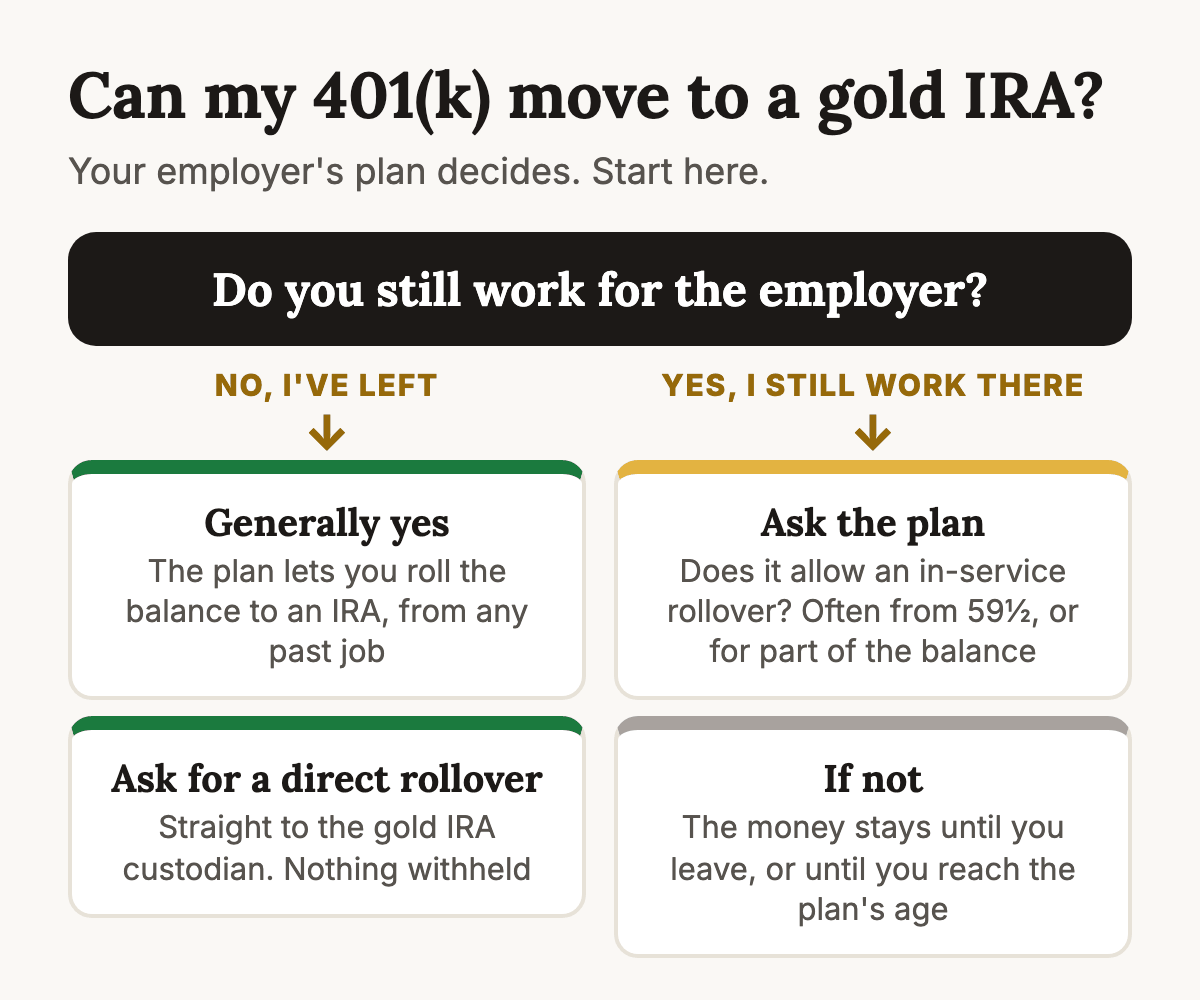
If you have left the employer, the plan will almost always let you roll the balance out. This is the most common situation, and it covers 401(k)s from any past job, however long ago.
If you still work there, it depends on the plan. Many plans do not allow money to leave while you are employed. Some allow what is called an in-service distribution once you reach a certain age, often 59½, and some allow it for part of the balance, such as money rolled in from an earlier job. Your plan's rules decide, not the IRS and not the gold company.
How to find out: read your plan's summary plan description, or call the number on your 401(k) statement and ask: "Does my plan allow an in-service rollover to an IRA, and if so, from which parts of my balance?" Write down the answer and the name of the person who gave it.
The same applies to similar employer plans. A 403(b) from a school or hospital, a governmental 457(b) and the federal Thrift Savings Plan can all generally be rolled into an IRA under the same pattern: easy after you leave, plan-dependent while you are still there.

Ask for a direct rollover, not a check
When your plan pays out, it can send the money in one of two ways, and they are treated very differently.
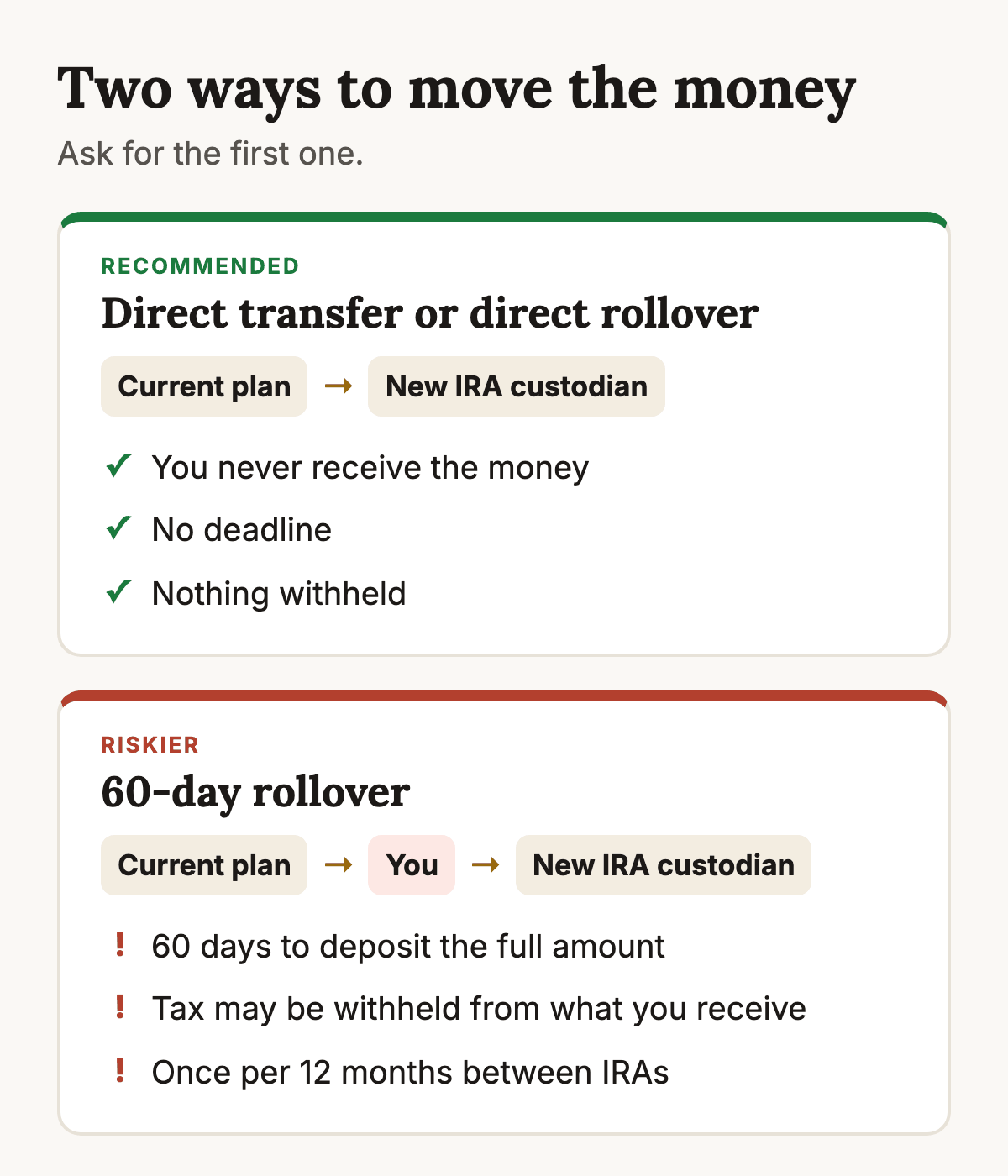
A direct rollover. The IRS describes this as asking your plan administrator to make the payment directly to another retirement plan or to an IRA. The money goes from the 401(k) to the gold IRA custodian. Nothing is withheld, there is no deadline, and it is not a taxable event. If the plan insists on cutting a check, it can still be a direct rollover, as long as the check is made payable to the new custodian for the benefit of your IRA, not to you.
A distribution paid to you. If the plan pays the money to you, the IRS says it is subject to mandatory withholding of 20%, even if you intend to roll it over later. You then have 60 days from the day you receive it to deposit it into an IRA.
That 20% is where 401(k) rollovers go wrong. Suppose your 401(k) balance is $150,000 and the plan pays it to you:
- You receive $120,000. The other $30,000 goes to the IRS as withholding.
- To roll over the full balance, you must deposit $150,000 into the gold IRA within 60 days. That means finding $30,000 from other savings.
- If you deposit only the $120,000, the missing $30,000 is treated as a distribution. It is taxed as income, and if you are under 59½ the 10% additional tax may apply as well.
- You get the withheld $30,000 back only as a credit when you file your tax return, months later.
A direct rollover avoids all of this. There is no reason to take the money yourself, and every gold IRA company is used to arranging a direct rollover with the plan. Our general gold IRA rollover guide compares the methods side by side.
Match the money to the right kind of IRA
A 401(k) balance can contain more than one kind of money, and each kind has a natural home.
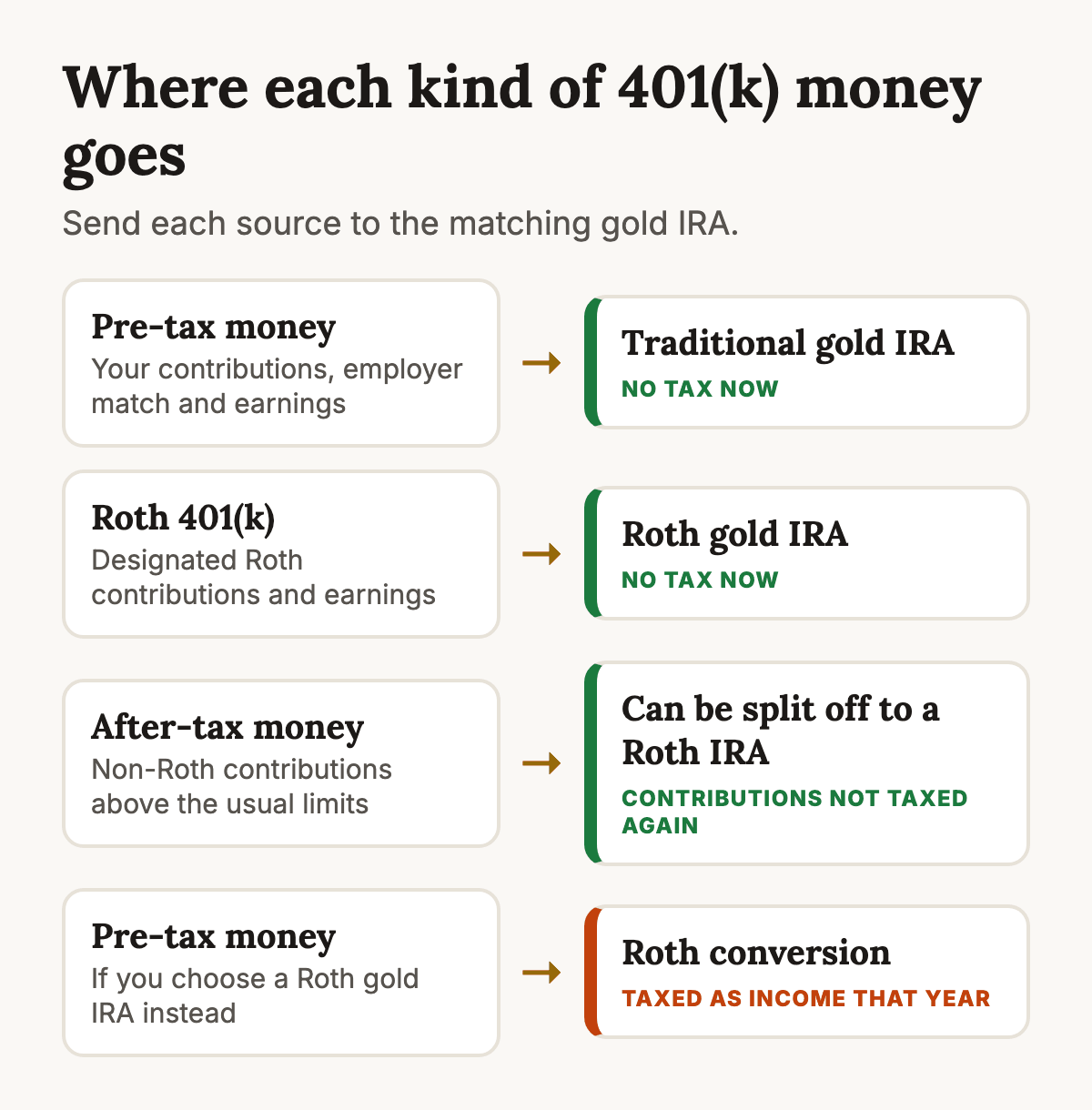
Pre-tax contributions and their earnings go to a traditional gold IRA. This is most 401(k) money. It stays tax-deferred, and you pay income tax when you take it out in retirement.
Roth 401(k) money (the IRS calls it a designated Roth account) goes to a Roth gold IRA. Qualified withdrawals stay tax-free. One detail: a Roth IRA has its own five-year clock for qualified withdrawals, so if you have never had a Roth IRA before, the years your money spent in the Roth 401(k) may not count toward it. Ask a tax professional if you expect to withdraw within the first few years.
After-tax (non-Roth) contributions, which some plans allow on top of the usual limits, can be split. The IRS says that when a distribution goes to several destinations at the same time, you can send all the pre-tax amounts to a traditional IRA and all the after-tax amounts to a different destination, such as a Roth IRA.
Pre-tax money into a Roth gold IRA is allowed, but it is a conversion, and the amount converted is added to your taxable income for that year. It can make sense for some people, but it is a tax decision, not a paperwork step.
If your statement shows more than one of these sources, ask the gold IRA company to open both kinds of account and ask the plan to send each source to the right one.
Three things to check before you sign
These are the 401(k)-specific points that general rollover guides tend to skip.
1. An outstanding 401(k) loan
If you have borrowed from your 401(k) and leave your job, many plans reduce your balance by the unpaid loan. The IRS calls this a plan loan offset, and it is treated as a distribution: taxable, and possibly subject to the 10% additional tax, unless you roll over an equal amount.
There is some relief. When the offset happens because you left the employer and within 12 months of leaving, it is a qualified plan loan offset, and the IRS gives you until your tax filing due date for that year, including extensions, to roll over the offset amount, using other money. That is far longer than 60 days, but you still need the cash. Ask the plan how it will handle the loan before you start the rollover.
2. Company stock in your 401(k)
If your 401(k) holds shares of your employer's stock that have grown in value, rolling them into an IRA may cost you a tax break. Under the net unrealized appreciation rules, the IRS says that when employer stock is taken out as part of a lump-sum distribution, the growth is generally not taxed until you sell the shares. Once the shares go into a traditional IRA, that treatment is lost, and whatever you later withdraw from the IRA is taxed as ordinary income. If this applies to you, speak to a tax professional before rolling those shares.
3. Leaving work between ages 55 and 59½
Normally, money taken from a 401(k) or an IRA before age 59½ faces a 10% additional tax. But the IRS has an exception for employer plans: if you leave your job during or after the year you turn 55 (50 for some public safety employees), withdrawals from that employer's plan are exempt from the 10% tax. This exception does not apply to IRAs.
So if you retire at 56 and expect to draw on your savings before 59½, rolling everything into an IRA can turn penalty-free withdrawals into penalized ones. One common approach is to roll only part of the balance into a gold IRA and leave enough in the 401(k) to cover those years. Check the numbers with a tax professional.
Which 401(k) payments cannot be rolled over
Not every payment from a plan can go into an IRA. The IRS list includes:
- required minimum distributions;
- hardship distributions;
- loans treated as distributions;
- a series of substantially equal periodic payments;
- corrective distributions of excess contributions.
If you are old enough for required minimum distributions, that year's required amount has to be taken out first. The rest of the balance can then be rolled over.
The good news for a 401(k) is that the once-a-year limit on IRA rollovers does not apply. The IRS says that limit does not cover plan-to-IRA rollovers, so you can roll several old 401(k)s into the same gold IRA in the same year.

The steps, from first call to gold in the vault
- Confirm your plan will release the money and find out which sources (pre-tax, Roth, after-tax) are in your balance.
- Check the three traps above: a loan, company stock, and the age-55 exception.
- Choose a gold IRA company. It sells you the metal and helps with the paperwork. Compare more than one; our ranking of the best gold IRA companies covers three.
- Open a self-directed gold IRA with the custodian the company works with. Open a Roth one as well if you have Roth money.
- Request a direct rollover from the 401(k) to the new custodian. Many plans need a form from you and a letter of acceptance from the custodian; the gold company usually prepares the second.
- Wait for the money to arrive. Timing depends mostly on your plan. Ask both sides for an estimate, and do not buy anything until the custodian confirms the funds.
- Choose IRA-eligible gold. Gold must be at least 99.5% pure, with an exception for the American Gold Eagle. Ask for the price of each item and the price the company would pay to buy it back today, in writing.
- The gold ships to an approved depository, and the custodian confirms it has arrived. Keep the confirmation with your records.
You will receive a Form 1099-R from the plan for the year of the rollover. A direct rollover is reported there as non-taxable. Keep it with your tax papers.
How much of the 401(k) to move
You do not have to move all of it. The IRS lets you roll over all or part of an eligible distribution, and many people move only a portion into gold and leave the rest in funds.
How much is right is a question about your own circumstances, not about gold. Gold pays no interest or dividends, its price can fall for years at a time, and our guide on whether to buy gold now or wait shows how far it has fallen in the past. A licensed financial professional who is not paid on the sale can help you decide on a share you would be comfortable holding through a long slump. Our gold IRA pros and cons lays out both sides.
Questions to ask a gold IRA company about a 401(k) rollover
- Have you handled rollovers from my plan provider before, and what forms will the plan need?
- Which custodian will hold the account, and which depository will store the gold?
- What is your minimum, and does it apply to the amount I am rolling over?
- What will I pay per ounce for each item you suggest, and what would you pay to buy the same items back today?
- What does the account cost each year, from the custodian and the depository? Please put every charge in writing.
- How long do rollovers from 401(k) plans usually take with you?
A good company answers each of these without pressure. If a salesperson steers you toward rare or "limited" coins for a retirement account, stop. Collectibles are not allowed in an IRA, and our gold scammer list shows what regulators have found when dealers pushed them.
Companies that handle 401(k) to gold IRA rollovers
All three companies we compare on this site arrange rollovers from 401(k)s and other employer plans, and each offers a free guide that costs nothing and commits you to nothing.
- Augusta Precious Metals works with Equity Trust Company as its preferred custodian and stores metals at Delaware Depository. Its minimum is $50,000, so it suits larger rollovers. It is our first-ranked company and leads with education before any sale.
- Goldco handles gold and silver IRA rollovers, has the most specific written buyback policy of the three, and currently advertises a free silver promotion on qualifying orders.*
- American Hartford Gold states a $10,000 minimum order for its self-directed gold IRA, which makes it the most accessible option for a smaller 401(k).
The full comparison is in our ranking, and our article on the free gold IRA kit explains what the companies' guides contain.
Claim Augusta's Free Gold IRA Kit
Claim Goldco's Free Gold IRA Kit
Claim American Hartford Gold's Free Guide
Mistakes to avoid
- Taking a check made out to you. You lose 20% to withholding and start a 60-day clock.
- Assuming you can move a current employer's 401(k). Ask the plan first.
- Sending Roth money to a traditional IRA, or pre-tax money to a Roth without meaning to convert.
- Forgetting an outstanding loan, which can become a taxable distribution when you leave.
- Rolling company stock without asking about net unrealized appreciation.
- Rolling everything at 55 when you will need money before 59½.
- Buying before the money lands, or buying collectible coins for the account.
- Storing IRA gold at home. It must be held by a bank or approved trustee.
FAQ
Can I roll my 401(k) into a gold IRA without paying tax?
Yes, if you use a direct rollover from the plan to the gold IRA custodian and keep the money the same type (pre-tax to a traditional IRA, Roth to a Roth IRA). Moving pre-tax money into a Roth gold IRA is a taxable conversion.
Can I move my 401(k) to gold while I still work for the employer?
Only if your plan allows an in-service distribution. Some plans do from age 59½ or for part of the balance; many do not. Ask your plan administrator.
How long does a 401(k) to gold IRA rollover take?
It depends mostly on how quickly your plan releases the money. Ask your plan and the gold IRA company for an estimate, and do not buy gold until the custodian confirms the funds have arrived.
Is the 20% withholding refunded?
Only as a tax credit when you file your return, and only the part you did not owe. If you deposited the full balance within 60 days, the rollover is complete, but you had to find the withheld amount from other money. A direct rollover avoids withholding entirely.
Can I roll over more than one old 401(k) in a year?
Yes. The IRS says the once-a-year limit on rollovers does not apply to plan-to-IRA rollovers.
Can I roll a Roth 401(k) into a gold IRA?
Yes, into a Roth gold IRA. The Roth IRA has its own five-year clock for qualified withdrawals, so ask a tax professional if you will need the money soon.
What happens to my 401(k) loan if I roll over?
If you have left the employer, the plan may offset the unpaid loan against your balance, which counts as a distribution. You can avoid tax on it by rolling over the same amount from other money by your tax filing due date, including extensions.
Can I keep the gold from my 401(k) rollover at home?
No. Gold in an IRA must be held by a bank or an IRS-approved trustee. Keeping it at home is treated as taking it out of the account.
Is a 401(k) to gold IRA rollover right for me?
That depends on your circumstances, and a website cannot judge them. Gold pays no income and its price can fall. Speak with a licensed financial professional who is not paid on the sale.
The bottom line
A 401(k) to gold IRA rollover is routine when the money moves by direct rollover and goes to the right kind of IRA. The 401(k)-specific work comes first: make sure your plan will release the money, check for a loan, company stock and the age-55 exception, and decide how much of your balance to move. Then choose a gold IRA company carefully, and get the price of the gold and the buyback price in writing before you approve the order.
Sources
- IRS: Rollovers of retirement plan and IRA distributions
- IRS: Rollovers of after-tax contributions in retirement plans
- IRS: Plan loan offsets
- IRS: Retirement topics, exceptions to tax on early distributions
- IRS Topic 412: lump-sum distributions
- IRS: Rollover chart (PDF)
- IRS: frequently asked questions about IRAs
- Augusta Precious Metals and American Hartford Gold websites, read on October 28, 2026.
Claim Augusta's Free Gold IRA Kit

*Applies only to qualified orders. Get up to 5% back in FREE Silver when you purchase $50,000 - $99,999. Get up to 10% in FREE Silver when you purchase $100,000 or more. Cannot be combined with any other offer. Additional rules may apply. Contact your representative to find out if your order qualifies. For additional details, please see your customer agreement. Goldco does not offer financial or tax advice.
More guides
 Gold IRA
Gold and Silver IRA Accounts: How They Work
How a gold and silver IRA account works: holding both metals in one account, what each must meet, how people divide them, storage, and who offers them. Gold IRA
Goldco vs Augusta Precious Metals: Which Is Better?
Goldco vs Augusta Precious Metals compared for 2026: ratings, minimums, buyback, storage and free kits, and which gold IRA company suits which buyer. Gold IRA
Goldco vs American Hartford Gold: Which Is Better?
Goldco vs American Hartford Gold compared for 2026: ratings, minimums, buyback, storage and free guides, and which gold company suits which buyer.Looking for a company to buy from? See how Augusta Precious Metals, Goldco and American Hartford Gold compare.
Compare the three companies