Silver
Is Silver a Good Investment in 2026? What the Data Shows
Silver has just lived through the most dramatic stretch in its modern history. In 2025 its price rose 142%. On January 26, 2026 it closed at a record $115.08 an ounce. Then it fell, sharply and then steadily, and on October 30, 2026 it closed at $49.10, its lowest close of the year and 57% below the record.
So is silver a good investment in 2026? The honest answer is that it depends on what you want it to do, how long you can hold it, and how much volatility you can live with. This guide looks at 25 years of silver prices, sets out the strongest arguments on each side, summarises what the industry's own data and one major bank currently say, and explains who silver tends to suit.
The short answer: silver can play a role in a diversified portfolio, especially for people who want a physical asset outside the financial system, but it is one of the most volatile things an ordinary buyer can own. Over 2001 to 2025 it rose in 16 years and fell in 9, and its daily swings were nearly twice as large as gold's. At today's price it is far cheaper than in January, but nobody knows whether the fall is over. If you buy, buy an amount you could hold through another 50% drop, and plan to hold it for years, not months.
This is general information, not personalized investment, financial or tax advice. Prices are COMEX silver futures daily closes through October 30, 2026. This page will be updated for 2027.
Claim Augusta's Free Gold & Silver IRA Kit
Where silver stands at the end of October 2026
On October 30, 2026, silver closed at $49.10 an ounce. Measured from different starting points:
| Compared with | Silver then | Change to $49.10 |
|---|---|---|
| August 30, 2000 | $4.93 | About 10 times higher |
| October 28, 2016 | $17.76 | Up 176% |
| October 29, 2021 | $23.94 | Up 105% |
| January 2, 2025 | $29.62 | Up 66% |
| October 30, 2025 | $48.43 | Up 1% |
| Last close of 2025 | $70.13 | Down 30% |
| January 26, 2026, the record close | $115.08 | Down 57% |
Two things stand out. Over any period longer than a few years, silver is well up. And over the past year it has gone nowhere, after a round trip of extraordinary size. It was the first close below $50 since November 21, 2025.
Gold, for comparison, closed at $3,898.90 on the same day, down about 10% for 2026. That puts the gold-to-silver ratio near 79: one ounce of gold buys about 79 ounces of silver.
25 years of silver, year by year
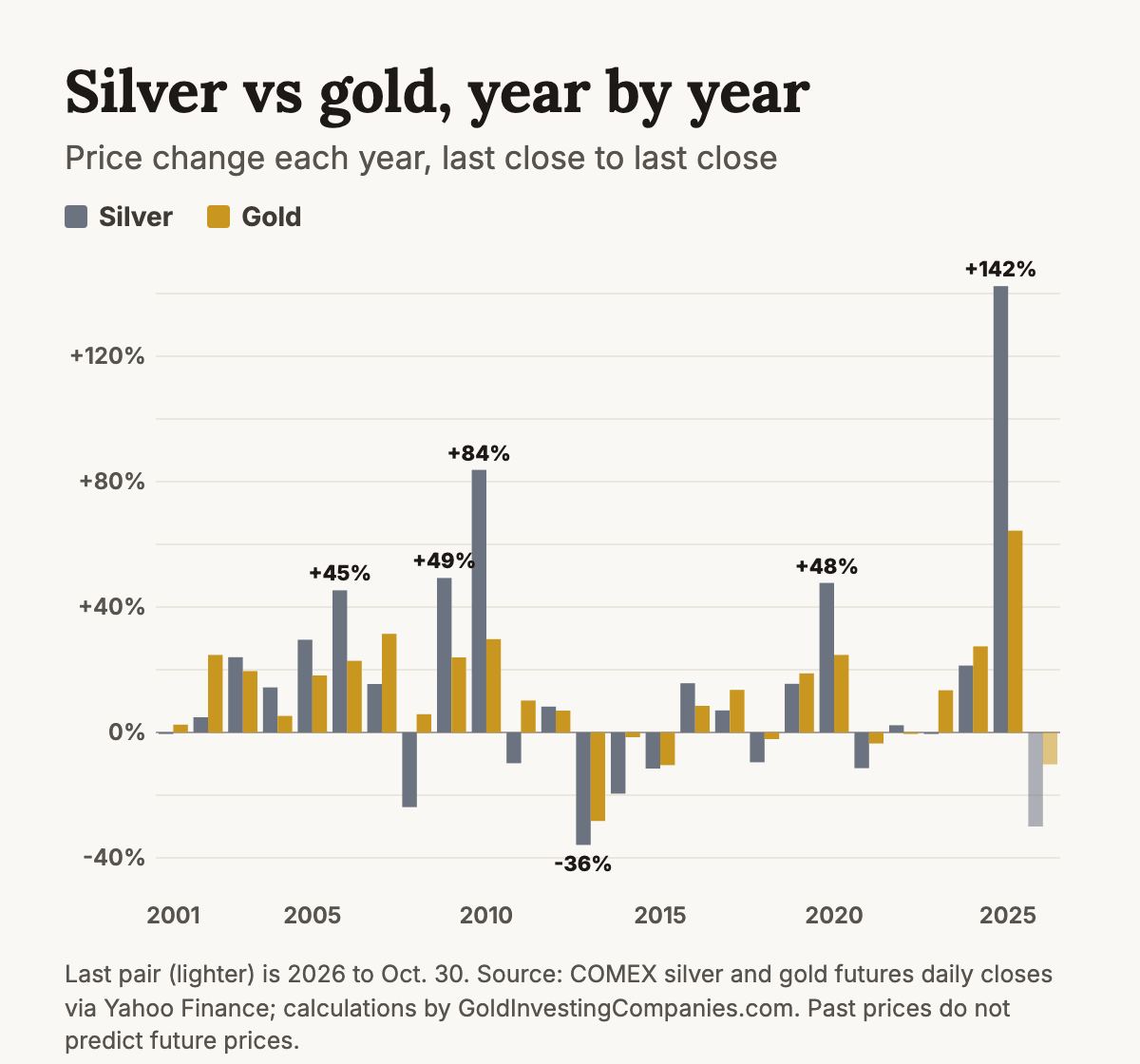
The chart shows each year's change in the price of silver and gold from 2001 to 2025, plus 2026 to October 30, measured from one year's last close to the next.
A few patterns run through it.
Silver rises more often than it falls, but not by much. From 2001 to 2025, silver ended the year higher in 16 years and lower in 9. Gold ended higher in 19.
Silver's good years are spectacular. 2025 (+142%), 2010 (+84%), 2009 (+49%), 2020 (+48%) and 2006 (+45%) were all far stronger than gold's best years.
Its bad years are brutal. 2013 (−36%), 2008 (−24%) and 2014 (−20%) were all worse than gold, and 2026 so far (−30%) is three times gold's fall.
It beat gold in fewer than half the years. Silver finished ahead of gold in 11 of the 25 years. Over the whole period, gold rose about 14-fold and silver about 10-fold.
Long waits happen. Silver closed at $48.58 in April 2011. It did not close above that again until October 2025, and at $49.10 today it is barely 1% above it. Someone who bought at the 2011 peak has waited fifteen and a half years to break even.

How volatile is silver?
Volatility is the single most important thing to understand before buying silver. Measured by the spread of its daily price moves, silver's annualised volatility from 2001 to October 2026 was about 34%, against about 18% for gold. In 2026 alone, it was about 70% for silver and 30% for gold.
In plain terms: silver typically moves about twice as far as gold, in either direction, over the same period. On January 30, 2026, it fell 31% in a single day, the largest one-day fall in our 26-year series.
That volatility is the reason silver can double in a year, and the reason it can halve. It is not a flaw to be fixed; it is the nature of a small market with heavy industrial demand and a lot of speculative money moving in and out.
The case for silver as an investment
These are the strongest arguments made for owning silver. Each has something to it.
It is a real asset outside the financial system. Physical silver is not anyone's liability. It cannot default, and it does not depend on a company's earnings or a government's promise. For many buyers, that is the main point of owning it.
Industrial demand underpins it. According to the Silver Institute's April 2026 report, industrial demand was 657.4 million ounces in 2025, more than half of total demand of 1.13 billion ounces. Silver goes into electronics, electrical systems and solar panels, which gives it a source of demand that does not depend on investors.
Supply has run short. The Silver Institute reported that demand exceeded supply in 2025 for the fifth consecutive year, and in April it expected the deficit to widen to 46.3 million ounces in 2026. Mine production rose 3% in 2025 to 846.6 million ounces, and recycling reached a 12-year high, but neither closed the gap.
Buyers of coins and bars are still active. The same report says coin and net bar demand rose 14% in 2025 and was expected to jump 18% in 2026.
It is much cheaper than it was. At $49.10, silver is less than half its January record. For someone who believes in the long-term case, a lower price buys more ounces for the same money.
It is accessible. Silver costs a small fraction of gold per ounce, so buyers can purchase in small units and sell part of a holding easily.
The case against silver as an investment
The arguments against are just as real.
It is extremely volatile. Silver has fallen by more than half three times since 2008: in 2008, from 2011 to 2015, and in 2026. If a 50% fall would force you to sell, or cause real hardship, silver is a risky place for that money.
It produces no income. Silver pays no interest, dividends or rent. Any return comes only from the price rising, and holding it costs money for storage and insurance.
Industrial demand cuts both ways. The same industrial use that supports silver can weaken it. The Silver Institute reported that industrial demand fell 3% in 2025 and that solar panel makers accelerated "thrifting and substitution", using less silver per panel, as prices rose. J.P. Morgan's research team said in August 2026 that solar demand for silver could fall about 30% this year.
Forecasts have been cut. In August 2026, J.P. Morgan lowered its silver forecasts, citing the unwinding of tight physical supply, weaker solar demand, softer Indian imports and expected interest rate rises. It now expects an average of $63.0 an ounce in the fourth quarter of 2026 and $63.9 for 2027, down from $90.0 and $85.8 in its May forecast. At $49.10, silver is already well below those revised figures, which shows how quickly views have had to change.
Long recoveries are possible. After 2011, silver took more than fourteen years to regain its high. Nothing guarantees a faster recovery this time.
Premiums and spreads eat into small purchases. Physical silver sells above the spot price, and dealers buy it back below the selling price. On small orders and collectible coins, that gap can be large compared with the metal's value.
What the forecasts can and cannot tell you
It is tempting to look for a price prediction. We list one above, J.P. Morgan's, because it is dated, specific and published openly by the bank. But treat any forecast with care:
- Forecasts change quickly. J.P. Morgan cut its 2026 average from $84.3 to $70.6 between May and August.
- They can be far off. In May 2026, J.P. Morgan expected silver to average $90.0 in the fourth quarter. It closed October at $49.10.
- They are opinions, however well researched. Nobody can see the future price of a metal this volatile.
Use forecasts to understand what professionals are worried about, not to decide when or how much to buy. Our guide on whether to buy silver now or wait shows what 26 years of prices say about timing.

Who silver tends to suit
Silver may suit you if:
- you want a modest share of your savings in a physical asset outside the financial system;
- you can hold it for many years and would not need to sell in a downturn;
- you are comfortable watching its value swing by 30% or more in a year;
- you already own gold, or plan to, and want a smaller, more volatile complement to it.
Silver may not suit you if:
- you need the money within a few years;
- you want income from your savings;
- a large fall would cause you real hardship or panic;
- you are buying mainly because the price has been in the news.
How much is the right share depends on your circumstances, and a licensed financial professional who is not paid on the sale is the right person to help you decide.
Silver or gold?
Many people weighing silver are really choosing between silver and gold, or deciding how to split between them.
- Gold has been steadier: smaller swings, fewer down years, and a larger rise over 25 years.
- Silver has had bigger upswings and deeper falls, more industrial exposure, and a lower price per ounce.
A common approach is to hold mostly gold with a smaller share in silver. Our comparison of a gold IRA vs a silver IRA covers the differences in detail, and gold and silver IRA accounts explains how to hold both in one account.
Ways to own silver
Physical silver you own outright. Coins, rounds and bars bought with your own money and kept at home, in a bank box or at a private vault. You can sell any time. Gains are taxed when you sell; the IRS treats bullion as a collectible, with a maximum rate of 28% on net long-term gains. Our guide to buying 1,000 ounces of silver covers the forms and storage.
A silver IRA. A self-directed IRA that owns physical silver, held at an approved depository. It can be funded by rolling over an existing 401(k) or IRA without tax, and the silver grows tax-deferred, or tax-free in a Roth. IRA silver must be at least 99.9% pure and cannot be kept at home. Our silver IRA rollover guide explains the steps.
Funds that track silver. Exchange-traded funds hold silver or silver futures and trade like shares. They are simple to buy and sell, but you own a share of a fund rather than metal in your name.
Whichever route you choose, compare the price per ounce and the buyback price in writing, and avoid collectible or "limited edition" coins if what you want is the metal.
Buying silver through Augusta Precious Metals
If you decide that physical silver belongs in your retirement savings, Augusta Precious Metals is the company we rank first on this site. It sells silver coins and bars for silver IRAs and for purchases with personal funds, and it builds its process around education rather than pressure: before any purchase, it offers a one-on-one web conference designed by its director of education, Devlyn Steele, for savers with $100,000 or more in savings.
Augusta works with Equity Trust Company as its preferred custodian and stores IRA metals at Delaware Depository, both named in advance. Its minimum purchase is $50,000, through an IRA or with personal funds. Augusta itself says it does not offer financial, investment, legal or tax advice, which is the right stance: its job is to explain the account and sell you the metal, not to tell you how much to own.
Its free Gold & Silver IRA Info Kit explains how a precious metals IRA works. Requesting it does not open an account or commit you to anything. Our Augusta Precious Metals review covers the company in detail.
Claim Augusta's Free Gold & Silver IRA Kit
FAQ
Is silver a good investment in 2026?
It can be part of a diversified portfolio for someone who can hold it for years and tolerate large swings. In 2026 to October 30, silver fell 30%, and it closed at $49.10, 57% below its January record. Whether it suits you depends on your circumstances, not on the year.
Is silver a better investment than gold?
Neither is better in general. From 2001 to 2025, gold rose in more years and rose further overall, while silver had bigger gains in its best years and bigger losses in its worst. Many people hold mostly gold with some silver.
Will silver go back up?
Nobody knows. Silver has recovered from every past fall so far, but sometimes only after many years: after 2011 it took more than fourteen. Forecasts vary widely and change often.
Why did silver fall so much in 2026?
Part of the reason is how far it rose: the 2025 rally was driven partly by tight physical supply, which J.P. Morgan said in August was unwinding. The bank also cited weaker solar demand, softer Indian imports and expected interest rate rises.
Is silver a good long-term investment?
From August 2000 to October 2026 it rose about tenfold, with long flat and falling stretches along the way. As a long-term holding it has rewarded patience, but it has never been steady.
How much silver should I own?
That is a personal decision. A common rule of thumb is to keep precious metals to a modest share of savings, with silver a smaller part than gold. Discuss it with a licensed financial professional who is not paid on the sale.
Is a silver IRA a good investment?
A silver IRA holds the same metal under retirement-account tax rules. It can make sense for retirement savings you will not need for many years. It adds custodian and storage costs, and the silver must stay at an approved depository.
The bottom line
Silver is a real asset with genuine industrial demand and a long record of rising over time, but it is also one of the most volatile things an ordinary buyer can hold. 2025 and 2026 showed both sides in a single year: a 142% gain followed by a 57% fall from the peak.
If you are considering silver, decide first what you want it to do, then choose an amount you could hold through another halving, and plan to keep it for years. Buy physical metal at a fair price from an established dealer, get the buy and buyback prices in writing, and treat any forecast as an opinion, not a promise.
Sources
- Silver and gold prices: COMEX silver (SI=F) and gold (GC=F) futures daily closes from Yahoo Finance, August 30, 2000 to October 30, 2026. Yearly changes, counts and volatility were calculated by us from that series. Futures closes can differ slightly from spot prices.
- Silver Institute: World Silver Survey 2026 press release, April 15, 2026
- J.P. Morgan Global Research: silver price forecast, August 13, 2026
- IRS Topic 409: capital gains and losses
- Augusta Precious Metals website, read on November 2, 2026.
Claim Augusta's Free Gold & Silver IRA Kit
More guides
 Silver
Should I Buy Silver Now or Wait? What 26 Years Show
Should you buy silver now or wait? A 26-year price chart, what history says about timing, the case each way, and a plan that doesn't need a forecast. Silver
 IRA Rollover: Rules, Steps and What to Buy
How a silver IRA rollover works: moving a 401(k) or IRA into silver without tax, the IRS rules, which silver qualifies, and how storage differs from gold. Silver
Buy 1000 Ounces of Silver: Cost, Forms and Where to Buy
How to buy 1,000 ounces of silver: what it costs, the bars and coins it comes in, how much it weighs, storage, taxes, and where to buy it safely.Looking for a company to buy from? See how Augusta Precious Metals, Goldco and American Hartford Gold compare.
Compare the three companies