Gold IRA
Gold IRA Fees: What You Pay For and How to Compare
Search for gold IRA fees and you will find tables of exact dollar amounts for every company. We do not publish those numbers, and this guide explains why. They change, they depend on the size and shape of your account, and the figures repeated around the internet are often out of date or simply wrong. A number that was accurate for one customer two years ago tells you little about the quote you will get.
What does not change is the structure. Every gold IRA involves the same handful of charges, paid to the same three parties, at the same points in the life of the account. Once you know what they are, you can ask the right questions, read any quote properly, and compare companies on what you would actually pay.
The short version: a gold IRA has two kinds of cost. The first is the account's running costs: setting it up, the custodian's yearly charge and the depository's storage charge. The second, often larger and less visible, is the price of the metal itself: the premium over the spot price when you buy and the gap to the buyback price when you sell. Ask every company for all of it in writing, for the same metal and the same amount, before you choose.
This is general information, not financial or tax advice.
Claim Augusta's Free Gold IRA Kit
Why we don't publish fee figures
Three reasons.
They go out of date. Custodians and depositories revise their schedules, and promotions come and go. A table that was right when it was written can be wrong a few months later, with no sign on the page that anything changed.
They depend on you. Many charges vary with the account: how much it holds, whether storage is pooled or kept separate, how many transactions you make, and whether you are moving money in by rollover or contribution. A single published number cannot reflect that.
The biggest cost is not on any schedule. The price you pay for the metal, and the price you could sell it for, usually matter more over the life of the account than the yearly account charges. No table of fees captures them.
So instead of figures, this guide gives you the map and the questions. The answers that matter are the ones a company puts in writing for you.
Who you pay: the three parties
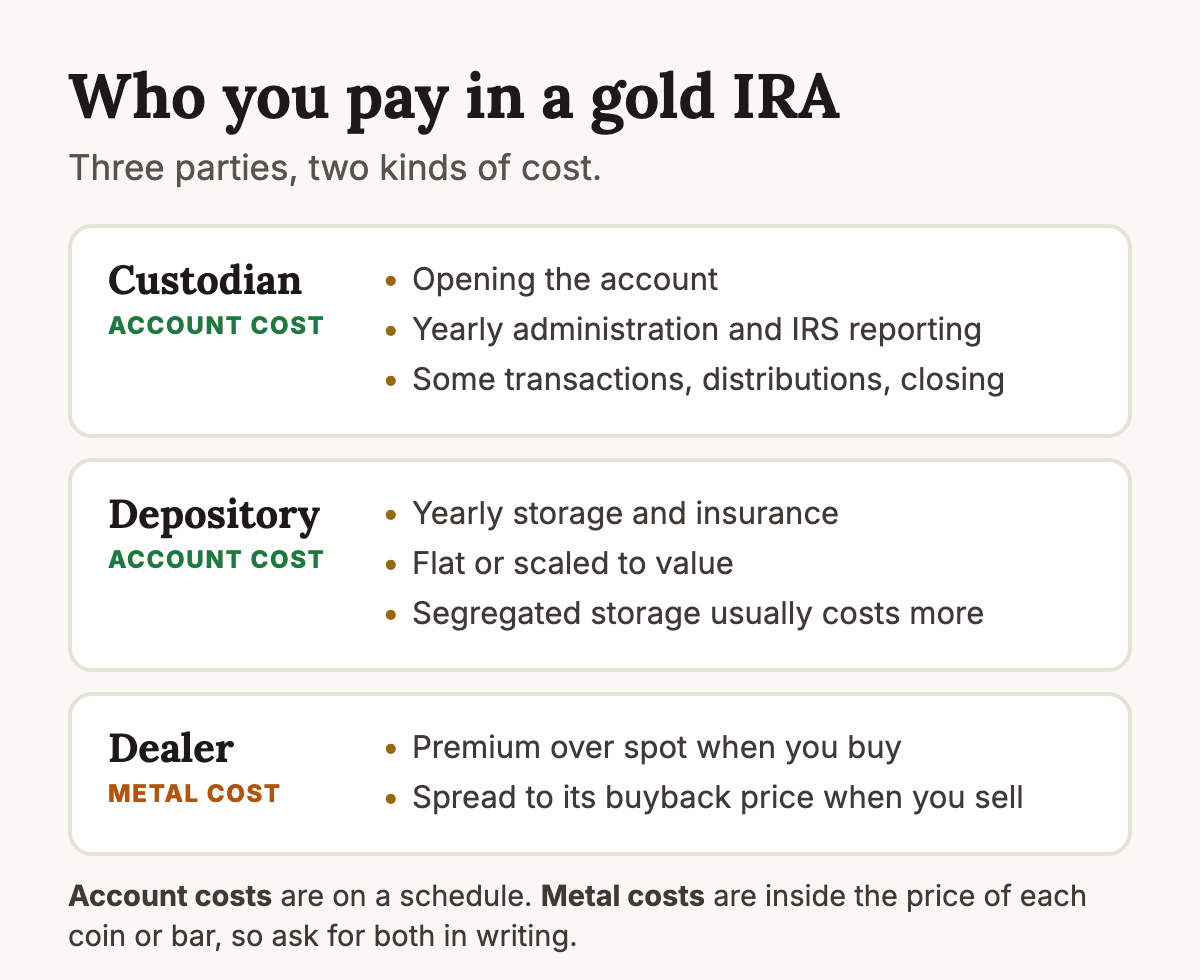
A gold IRA has three parties, and each charges for its part.
- The custodian holds the IRA, keeps its records and reports to the IRS. Gold IRAs need a custodian that handles self-directed accounts, because ordinary brokerages do not hold physical metal.
- The dealer, the gold IRA company, sells you the coins and bars and usually guides the paperwork. Its income comes mainly from the price of the metal.
- The depository stores the metal. IRS Publication 590-B says IRA coins must be in the possession of the custodian or trustee, so the gold sits in an approved vault, not at home.
Some companies collect the custodian's and depository's charges on their behalf, or cover some of them for a period. Either way, the charges themselves come from the custodian and the depository.

The charges, one by one
One-time charges when you open the account
- Account setup. Some custodians charge to open a self-directed IRA. Some dealers cover it for new customers.
- Transfer or rollover charges. Your old provider may charge to close an account or send the money. Ask it directly; the new company cannot answer for your old one.
- Wire or processing charges for moving money, depending on the institutions.
These happen once and are usually small relative to the account. They are worth knowing about but rarely decide the choice.
Yearly charges while you hold the gold
- Custodian administration. A yearly charge for keeping the account, its records and its IRS reporting.
- Storage. The depository's yearly charge for holding the metal, usually including insurance. Some storage is charged as a flat amount; some is scaled to the value of the metal held. Ask which, because it changes how the cost grows with the account.
- Segregated storage. Keeping your own coins and bars apart from other clients' metal usually costs more than commingled storage, where metal is pooled and you receive equivalent pieces back.
These repeat every year for as long as the account exists, so over ten or twenty years they add up. Small differences between flat and value-scaled storage become larger as the account grows.
Charges when you buy, sell or take metal out
- The premium over spot. Built into the price of each coin or bar. Covered in the next section.
- Transaction or trade charges. Some custodians charge per purchase or sale.
- Shipping and insurance to or from the depository, sometimes included in the price.
- Distribution charges when you take cash or metal out of the IRA, and shipping if the metal is sent to you.
- Account closing or transfer-out charges if you move the IRA to another custodian or close it.
Closing and transfer-out charges are easy to overlook when opening an account. Ask about them at the start, because they affect how easily you can change your mind later.
The cost that isn't on the fee schedule: premium and spread
The price of physical gold is quoted against the spot price, the market price for gold traded in bulk. Nobody sells coins or bars at exactly that price.
The premium is the amount above spot that you pay for each item. It covers minting, distribution and the dealer's margin, and it varies widely:
- Bullion bars usually carry the smallest premiums.
- Government-minted bullion coins, such as the American Gold Eagle, cost more but are easy to sell.
- Proof, collectible and "exclusive" coins carry the largest premiums, sometimes far more than the gold in them is worth.
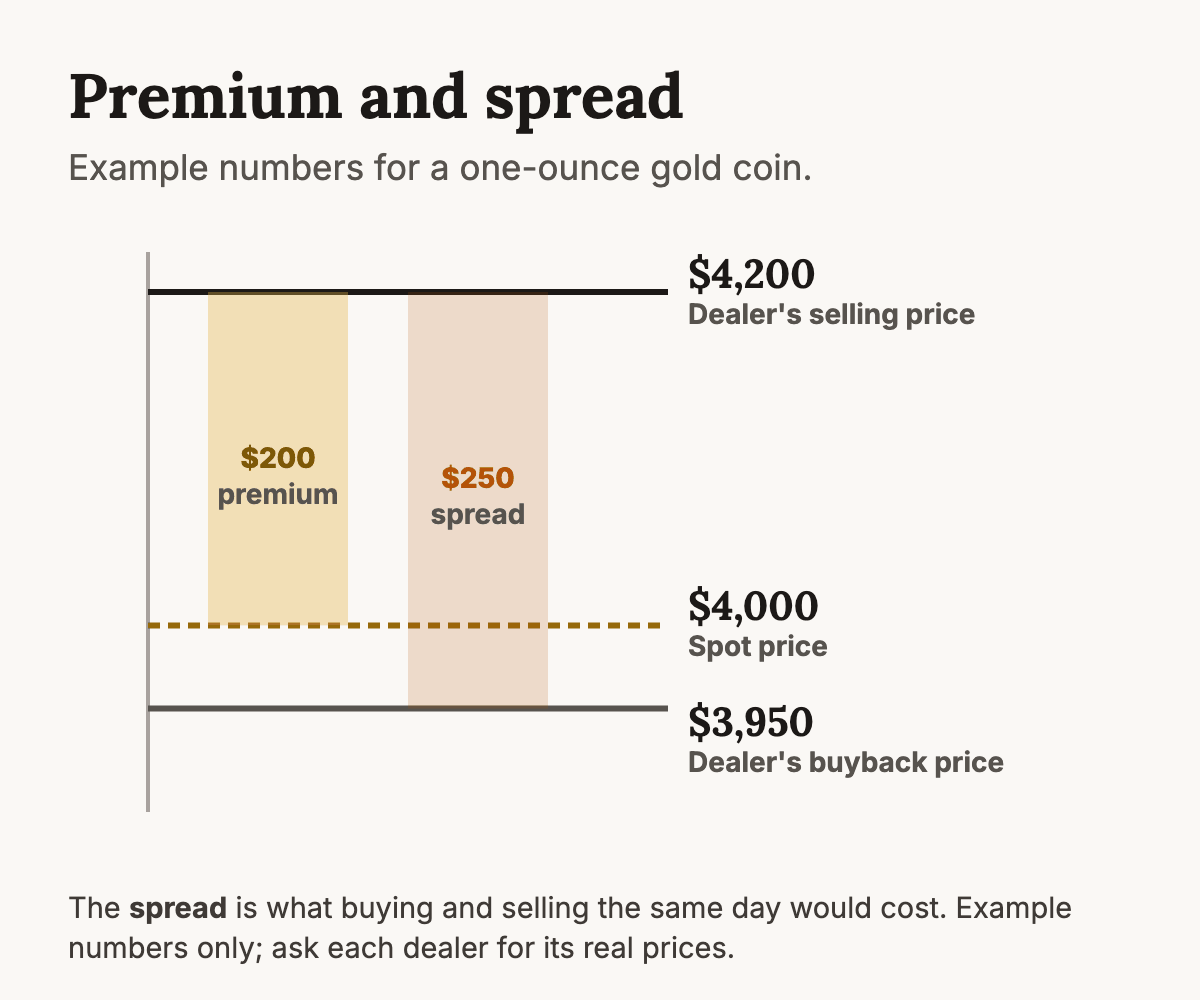
The spread is the gap between what the dealer charges you for an item and what it would pay to buy the same item back. That gap is your real cost of owning the metal: if you bought and sold on the same day, it is roughly what you would lose.
A simple example with made-up numbers. Suppose spot is $4,000 an ounce, a dealer sells you a one-ounce coin for $4,200 and would buy it back today for $3,950. You have paid $200 over spot, and the coin would need to rise $250 in value before you could sell it for what you paid. On a large order, that gap can easily exceed many years of account charges.
This is why a company advertising low yearly charges is not necessarily cheaper. A higher price on the metal can cost far more than the account charges it saves you. Always compare the buy price and the buyback price of the same items, side by side.
Who pays: inside or outside the account
Account charges can usually be paid in one of two ways: from cash held inside the IRA, or by you directly from money outside it. The IRS has two rules on this, both in Publication 590-A:
- Trustees' administrative charges are not subject to the contribution limit. Paying the custodian's charges from outside money does not use up your annual IRA allowance.
- They are not deductible. Publication 590-A says administrative charges billed separately and paid in connection with a traditional IRA are not deductible as IRA contributions, and cannot be taken as an itemized deduction either.
Paying from outside keeps all of the metal in the account. Paying from inside means the IRA needs some cash, or has to sell a little metal, to cover them. Ask the custodian which methods it accepts and what happens if a charge goes unpaid. Brokers' commissions are treated differently: the IRS says those count toward the contribution limit.
Promotions and "no fees" offers
Gold IRA companies often advertise offers such as covering account charges for a number of years. These can be worth real money. They can also distract from the price of the metal.
When you see an offer, ask:
- What exactly is covered, and for how long?
- What happens when it ends? Ask for the charges that will apply afterwards, in writing.
- Does it depend on the order size or on buying particular products?
- How do the prices of the metal compare with and without the offer? An offer is only worth having if the metal is fairly priced.
Read the written terms of any promotion before you rely on it.

How to compare gold IRA costs
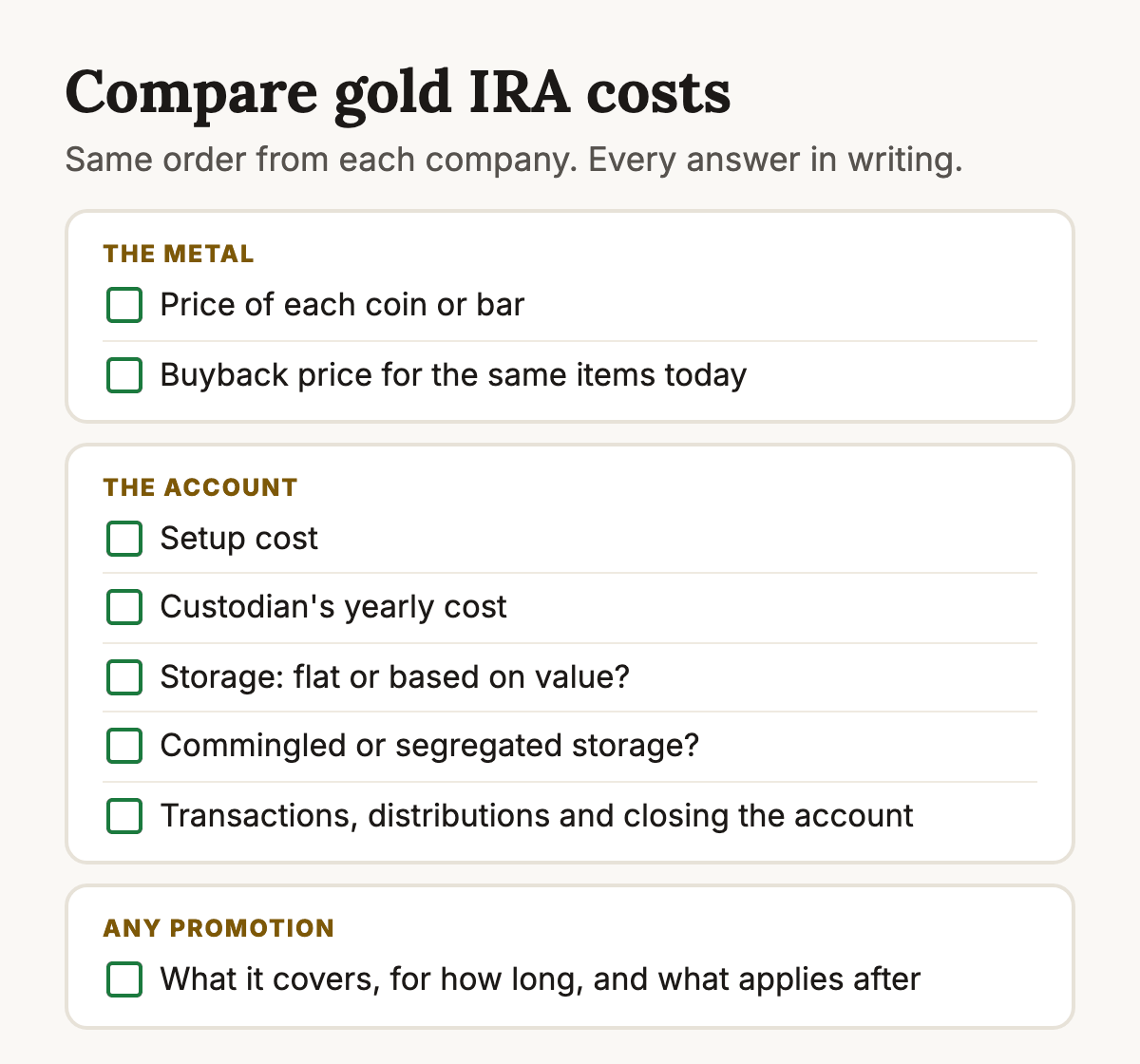
The only reliable comparison is one you build yourself, from written quotes for the same thing.
- Pick a realistic order. The amount you plan to move and the kind of metal you want, such as one-ounce American Gold Eagles or one-ounce bars.
- Ask two or three companies to quote that exact order. Same items, same quantity.
- For each, get in writing: the price per item, the total, and the price the company would pay to buy the same items back today.
- Get the account costs in writing: setup, the custodian's yearly charge, storage (flat or scaled, commingled or segregated), and charges for transactions, distributions and closing the account.
- Ask what is covered by any promotion, for how long, and what applies afterwards.
- Add it up over the time you expect to hold the gold. Ten years is a reasonable test. Include the spread on the metal as well as the yearly charges.
Lay the answers side by side. The company with the lowest total over your time horizon, with terms you understand, is the cheaper one, whatever its advertising says.
Warning signs
Some patterns suggest a company is making its money in ways it would rather you did not notice.
- Reluctance to quote a buyback price. A dealer should be able to tell you what it would pay today.
- Steering toward proof or "exclusive" coins for an IRA. Their premiums are high and their resale value uncertain. Collectible coins are not allowed in an IRA at all.
- Pressure to decide on the first call, or offers that expire today.
- Vague answers about the custodian or depository. You should know who holds the account and where the metal is.
- "No fees" with no written terms. Ask what is covered and for how long.
Our guides to the gold scammer list and gold bar scams show what regulators have found when these patterns went further.
Keeping costs down
- Choose bullion, not collectibles. Standard coins and bars carry the lowest premiums.
- Ask for commingled storage if you do not need your own pieces back; it usually costs less.
- Buy in one larger order rather than many small ones, if that suits your plan, so per-transaction charges apply less often.
- Consider paying account charges from outside the IRA, so no metal has to be sold to cover them.
- Hold for the long term. The spread is paid once on the way in and out; frequent trading pays it repeatedly.
- Check the costs every year. Read the custodian's statement and the depository's invoice, and ask about any change.
How Augusta Precious Metals handles costs
Augusta Precious Metals, our first-ranked company, says it puts its costs in writing and explains the spread before any purchase, which is the right starting point for the comparison above. It works with Equity Trust Company as its preferred custodian and stores metals at Delaware Depository, both named in advance, so you know which institutions' terms to ask about. Its minimum purchase is $50,000, and its free Gold & Silver IRA Info Kit explains the account in writing. Requesting the kit does not open an account or commit you to anything.
The other companies we compare, Goldco and American Hartford Gold, are covered in our ranking, and our best gold IRA companies guide compares all three on their public records. Whichever you consider, ask each one for the same written quote.
Claim Augusta's Free Gold IRA Kit
Claim Goldco's Free Gold IRA Kit
Claim American Hartford Gold's Free Guide
FAQ
What fees does a gold IRA have?
Typically a setup charge, a yearly custodian charge, a yearly storage charge from the depository, and charges for some transactions, distributions and closing the account. On top of these is the premium you pay over the spot price for the metal, and the spread to the dealer's buyback price.
Why don't you list each company's fees?
Because they change, they vary with the account, and the numbers published online are often wrong. We explain the structure and the questions to ask, so you can get accurate figures in writing from each company.
Are gold IRA fees tax deductible?
According to IRS Publication 590-A, trustees' administrative charges billed separately and paid in connection with a traditional IRA are not deductible as IRA contributions, and cannot be taken as an itemized deduction. Ask a tax professional about your own situation.
Can I pay gold IRA fees from outside the account?
Usually, if the custodian allows it. IRS Publication 590-A says trustees' administrative charges are not subject to the contribution limit, so paying them from outside money does not use up your annual allowance.
What is the biggest cost of a gold IRA?
Often the price of the metal rather than the account charges: the premium you pay over spot and the gap to the buyback price. Compare those for the same items before comparing yearly charges.
Is storage cheaper if my gold is pooled with others?
Commingled storage usually costs less than segregated storage, where your own pieces are kept apart. Both are legitimate. Ask which one a quote assumes.
Are "no fee" gold IRA offers real?
Many are, for a set period and under conditions. Ask exactly what is covered, for how long, and what applies afterwards, and compare the price of the metal with and without the offer.
Is a gold IRA worth the cost?
That depends on your circumstances, which a website cannot judge. Gold pays no interest or dividends, and its price can fall. Speak with a licensed financial professional who is not paid on the sale. Our gold IRA pros and cons guide sets out both sides.
The bottom line
The question to ask about gold IRA fees is not "what is the number?" but "what will this cost me, all in, for the metal I want, over the time I plan to hold it?" The account charges matter, and they repeat every year. But the price of the metal and the buyback price often matter more, and no fee table shows them.
Ask two or three companies to quote the same order, get every cost and the buyback price in writing, and add it up over ten years. That comparison, not an advertised number, tells you which is cheaper.
Sources
- IRS Publication 590-A: contributions to IRAs (trustees' fees and brokers' commissions)
- IRS Publication 590-B: distributions from IRAs (custodian possession of IRA coins)
- Augusta Precious Metals website, read on November 2, 2026.
Claim Augusta's Free Gold IRA Kit
More guides
 Gold IRA
 vs Physical Gold: Taxes, Storage and Access
Gold IRA vs physical gold you keep yourself: how each is taxed, where the metal is stored, what you can buy, how you sell, and which suits which buyer. Gold IRA
 Tax Rules: Contributions, Withdrawals and RMDs
Gold IRA tax rules for 2026: contribution limits, how withdrawals are taxed, Roth rules, RMDs on metal, in-kind distributions, and mistakes that trigger tax. Gold IRA
401(k) to Gold IRA Rollover: Rules, Steps and Pitfalls
How to roll a 401(k) into a gold IRA: when your plan lets money leave, the direct rollover, the 20% withholding trap, Roth and loan rules, and the steps.Looking for a company to buy from? See how Augusta Precious Metals, Goldco and American Hartford Gold compare.
Compare the three companies